
AI virtual staging is transforming how homes are marketed by solving the "empty room problem." It uses advanced technology to add lifelike furniture and decor to property photos, helping buyers visualize spaces and making listings stand out online. Compared to physical staging, AI staging is faster, more affordable, and delivers high-quality results.
Here’s why it’s a game-changer:
- Cost Savings: Physical staging costs $1,000–$7,200, while AI staging costs $1–$99 per image – a savings of up to 98%.
- Faster Turnaround: AI staging delivers results in 12–48 hours, compared to 1–2 weeks for physical staging.
- Better Results: Virtually staged homes sell 73%–75% faster, attract 40%–72% more online traffic, and often sell at or above asking price.
AI staging is simple: upload a photo, choose a style, and receive a staged image ready for MLS. By labeling photos as "Virtually Staged", agents comply with guidelines while showcasing a property’s potential. With these benefits, AI staging is becoming a must-have tool for real estate professionals.
Create Stunning Staged Photos in Minutes – Best Virtual Staging App For Realtors And Photographers
sbb-itb-7eef225
Benefits of AI Virtual Staging for Real Estate Marketing
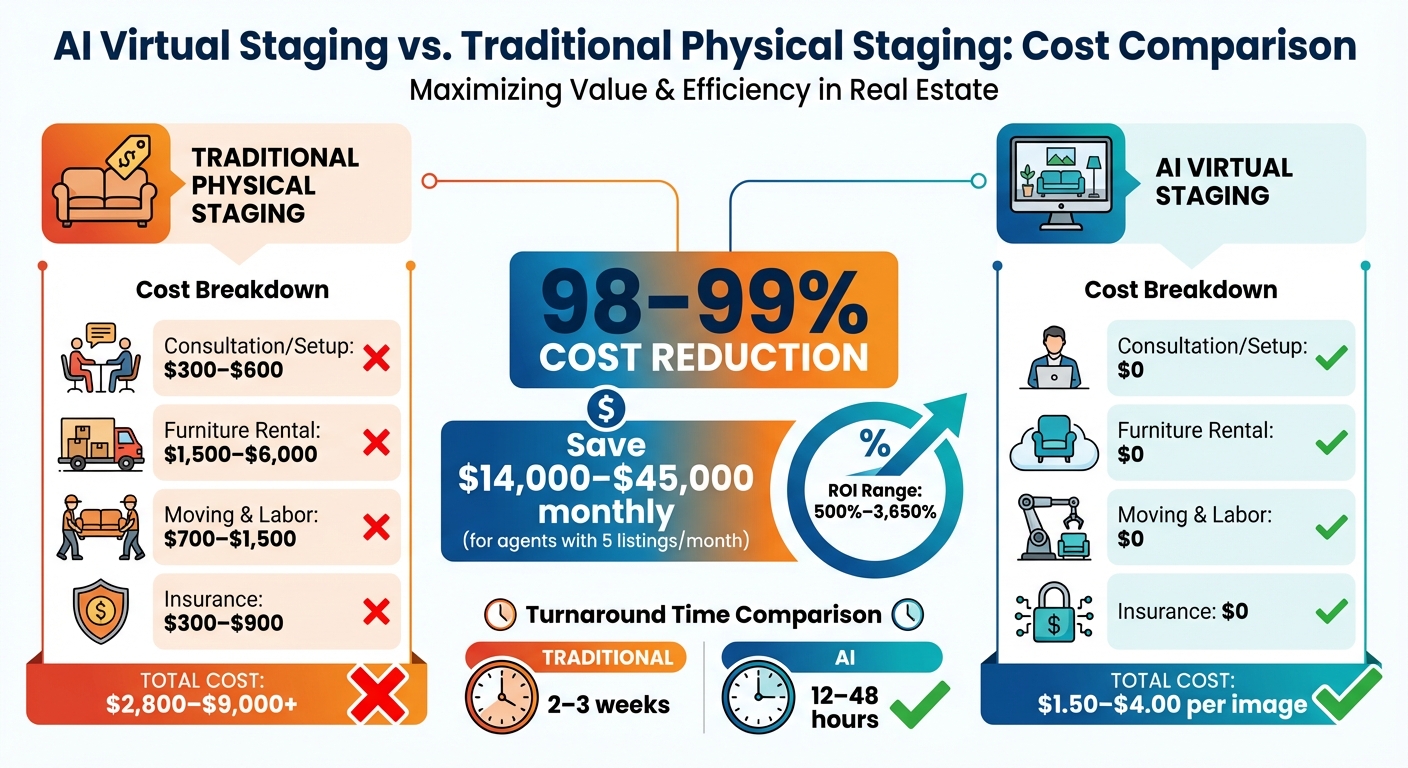
AI Virtual Staging vs Traditional Physical Staging Cost and Time Comparison
AI virtual staging offers three major benefits compared to traditional staging: quicker sales, increased online engagement, and cost savings of up to 98%. These advantages redefine how properties move from listing to closing.
Faster Property Sales with AI Staging
AI-staged homes sell 73%–75% faster than unstaged ones. On average, staged properties spend just 24 days on the market, compared to 90 days for unstaged homes.
Not only does virtual staging speed up the selling process, but it also increases sale prices by 5%–15%. For a $400,000 home, this could mean an additional $20,000–$60,000 in profit, all for an investment of less than $100. Impressively, 83% of virtually staged properties sell at or above their asking price. AI staging also allows homes to be updated and listed in just hours after photography – far faster than the 1–4 weeks required for traditional staging. Additionally, it enables agents to create multiple styled versions of the same room, targeting various buyer preferences.
Beyond speeding up sales, AI staging plays a crucial role in attracting more online attention.
Increased Online Views and Engagement
While selling a home quickly is key, grabbing attention online is just as critical. With 97% of homebuyers starting their search online, listing photos act as a property’s first impression. Buyers form an emotional connection to a home within the first 3 seconds of seeing its photos.
"The screen is the new front door." – Stager AI
Virtually staged listings outperform the competition by receiving 40%–50% more views online, driving a 72% increase in overall traffic, and generating 44% more qualified inquiries. Enhanced visuals improve click-through rates by 15%–30%, and staged homes garner 74% more interest from serious buyers. Staged images also help buyers visualize room dimensions and functionality, reducing what’s often called "scale anxiety." According to 81%–83% of buyers’ agents, staging helps clients see a property as their future home.
Lower Costs and Faster Turnaround Than Physical Staging
Traditional staging for a three-bedroom home typically costs between $2,800 and $9,000, while AI virtual staging costs just $1.50 to $4.00 per image – a massive 98%–99% reduction. For agents handling five listings a month, switching to AI staging can save $14,000 to $45,000 monthly.
| Expense Category | Traditional Physical Staging | AI Virtual Staging |
|---|---|---|
| Consultation/Setup | $300–$600 | $0 |
| Furniture Rental | $1,500–$6,000 | $0 |
| Moving & Labor | $700–$1,500 | $0 |
| Insurance | $300–$900 | $0 |
| Total Cost | $2,800–$9,000+ | $1.50–$4.00 |
| Turnaround Time | 2–3 weeks | 12–48 hours |
AI staging eliminates all logistical expenses – there’s no need for furniture rentals, moving services, interior design consultations, or extra insurance. Many AI platforms also allow instant style changes at no additional cost, unlike traditional staging, which involves new contracts and added labor. This flexibility makes it feasible to stage every property, including budget-friendly homes and rentals, not just luxury listings. With returns on investment ranging from 500% to 3,650%, virtual staging ensures consistent appeal across all property types and price points.
How AI Virtual Staging Works
AI virtual staging transforms empty property photos into fully furnished, inviting spaces in just seconds – sometimes as quickly as 30 seconds. The process starts when you upload a high-resolution photo to the platform. For the best results, use a wide-angle lens (16–24mm) and capture the shot from a corner at eye level (4.5–5 feet) to provide clear spatial context.
Once the photo is uploaded, you’ll choose the room type, such as a living room, primary bedroom, or home office, and select a design style like Modern, Scandinavian, or Industrial. From there, the AI gets to work. Using computer vision, it identifies key elements like floors, walls, ceilings, windows, and doors. By analyzing depth and perspective, the system converts the 2D image into a 3D map, ensuring that the virtual furniture is placed with proper scale and orientation.
After mapping the room, the AI fine-tunes the scene by analyzing ambient lighting. It detects both natural and artificial light sources to calculate accurate shadow placement and intensity for the staged elements. With deep learning models trained on millions of interior design images, the AI generates photorealistic furniture and décor that seamlessly integrates into the original photo. According to the National Association of Realtors:
Generative AI can virtually stage a photo of a vacant space in 30 seconds.
Most platforms provide 2–4 realistic design options to choose from. Advanced tools even allow micro-editing, such as using brush or mask tools to adjust individual items or tweak shadows without redoing the entire image. Once the staging is finalized, the high-resolution JPEG (usually 2,000–2,400 pixels wide in sRGB format) is ready for download.
To comply with MLS guidelines, always label these images as "Virtually Staged" in captions or watermarks and include the original, unaltered photo alongside the staged version. This ensures transparency while giving potential buyers a clear vision of the property’s possibilities.
Fast Virtual Staging: Features and Capabilities

Fast Virtual Staging offers a suite of AI-driven tools designed to transform empty property listings into visually appealing, market-ready homes in record time. Tailored for agents, brokers, and photographers, this platform combines cutting-edge technology with practical features to deliver reliable results – even on tight deadlines. Here’s a closer look at what makes it stand out.
Photo-Realistic Renders
Using advanced AI algorithms, Fast Virtual Staging creates furniture and décor that look like they belong in the room. The platform takes into account existing lighting conditions, ensuring shadows and reflections align perfectly with the room’s natural light. By analyzing dimensions and perspectives, it places furniture with precision, avoiding any awkward visual distortions.
You can choose from a variety of design styles, including Modern, Minimalist, Coastal, Scandinavian, Mid-Century, and Luxury. For example, a beach house can be styled with coastal themes, while a city loft might feature sleek, urban furnishings. High-resolution textures bring these designs to life, capturing details like wood grains and fabric weaves, making the images virtually indistinguishable from professionally staged photos.
12-24 Hour Turnaround
One of the platform’s biggest advantages is its 12-24 hour turnaround for residential projects. This means you can photograph a property in the morning and have fully staged images ready for MLS by the next day.
This speed provides flexibility, especially when market demands shift. If buyer feedback suggests a different design style might attract more interest, you can quickly request new renders – no need to wait for physical furniture swaps. This rapid response allows agents to focus on selling rather than waiting for staging updates.
Easy Revisions and Dedicated Support
Fast Virtual Staging doesn’t just stop at quick delivery – it also ensures a smooth revision process and personalized support. A dedicated account manager is available to handle changes, whether it’s adjusting furniture placement or trying out a new design style. The process is simple, with no cumbersome forms or drawn-out approval steps.
This level of support is especially helpful when dealing with unique properties or demanding clients. Your account manager understands the fast-paced nature of real estate and can prioritize urgent requests to meet your deadlines. The goal is to deliver images you’re completely satisfied with before they go live.
White-Label Solutions for Professionals
For professionals looking to expand their services, the platform offers a white-label program. This feature allows photographers and marketplaces to provide branded virtual staging services without investing in AI development or hiring in-house designers. You maintain control of client relationships while Fast Virtual Staging handles the technical work behind the scenes.
White-label partners benefit from discounted pricing, reducing the standard $20-25 per image rate and boosting profit margins. Delivered in high-resolution JPEG format (2,000-2,400 pixels wide in sRGB), the images meet the requirements for platforms like Zillow, Redfin, and Realtor.com. Whether you’re an independent photographer or managing a large network of agents, this program seamlessly integrates into your workflow, enhancing your service offerings without added complexity.
Using AI Virtual Staging in Your Marketing Workflow
Integrating AI virtual staging into your marketing process is simpler than you might think. By following a few straightforward steps, you can create market-ready visuals quickly and efficiently, saving both time and resources.
Start by using high-quality photos as the foundation. Ensure your images are high-resolution – at least 3,000 pixels on the longest side – in JPG or PNG format. Position your shots from corners or doorways to capture two walls at once, which helps the AI interpret depth. Keep the camera at eye level and use balanced interior lighting to enhance the space’s warmth and reduce harsh shadows. Natural light works best, with mid-morning or early afternoon being ideal times for shooting.
Before uploading, declutter the space by removing personal items and unnecessary objects. While AI tools can erase furniture, starting with a clean and empty room enhances the final render’s realism. Once your photos are prepped, upload them to a platform like Fast Virtual Staging. Select the room type and a design style that complements the property. For example, Modern Minimalist works well for condos and new developments, Traditional or Farmhouse suits suburban family homes, and Luxury Contemporary – with sleek furniture and metallic accents – is ideal for upscale listings. For commercial or specialized spaces, adjust furniture scale to match the room’s purpose and dimensions. These steps ensure the final renders align seamlessly with your listing’s overall aesthetic.
The platform typically delivers staged images within 12–24 hours. This turnaround gives you ample time to review the results and request any necessary changes through your account manager. Focus on staging high-impact rooms like the living room, primary bedroom, and kitchen/dining area, as these spaces significantly influence buyer perception. In fact, staged listings can receive 40–50% more online views compared to unstaged properties.
When publishing your listing, lead with a staged "hero shot" in the gallery for maximum impact. Be sure to include a "Virtually Staged" watermark or caption to meet MLS guidelines and maintain transparency with potential buyers. Many MLS jurisdictions, such as Canopy MLS, also require the original unstaged photo to be uploaded immediately after the staged version. This approach helps buyers understand the property’s actual condition while still benefiting from the visual appeal of staging.
For commercial properties or specialized spaces, consider practical yet visually appealing furniture choices. For example, home offices benefit from minimalist desks (around 60 inches) and ergonomic chairs, while dining areas often work best with round tables (48 inches) to maintain flow in smaller spaces. Always ensure the furniture scale matches the room’s dimensions – use fixed references like door heights (approximately 80 inches) to keep proportions accurate. This attention to detail elevates both residential and commercial listings, ensuring they present as polished and professional.
Case Studies and Performance Data
AI virtual staging has become a game-changer in real estate, enhancing every stage of the sales process. Listings with virtual staging achieve click-through rates of 3.5–4.5%, compared to just 1.8–2.2% for empty rooms. On top of that, these listings hold viewers’ attention 70% longer – extending viewing times from 27 seconds to 45–60 seconds. These benefits are clearly demonstrated in real-world examples.
Take Brenda Devlin’s experience in September 2024. As a real estate agent, she marketed a 3-bedroom condo in Palm Desert, California, priced at $475,000. By spending $450 on virtual staging, the property sold in just 28 days for $468,500 – 98.6% of the asking price. For comparison, similar unstaged units in the area typically stayed on the market for 67 days and sold for 96% of the asking price, or about $456,000. Thanks to the higher sale price and reduced carrying costs, the seller gained a net benefit of $15,950, translating to a staggering 3,544% return on investment.
The success of AI staging isn’t limited to the U.S. It’s making waves in Europe too. In Barcelona, Eva López, founder of Fincas Eva, used AI virtual staging for a residential property. The results? Lead volume skyrocketed from 2 per week to 3 per day – a tenfold increase – and the property sold at full asking price in just 5 days. Similarly, Carlos Domínguez of Kivir Home in Seville saw average days on market drop from 67 to 34, a 49% reduction. Listing views surged by 63%, and staging costs plummeted from €2,000 for traditional methods to just €24 using AI.
AI staging also excels in rental markets. Patrick-Luis Solyom, CEO of Solyom Immobilien in Mönchengladbach, Germany, used virtual staging on a rental property that had been sitting vacant for 90 days. The result? It was rented within just 7 days, while staging costs were slashed by 88% compared to manual methods.
Industry-wide data backs up these success stories. Virtually staged homes typically spend 29–31 days on the market, compared to 52 days for empty properties – a reduction of around 40–60%. Furthermore, 68% of agents report that virtual staging improves their ability to win over sellers. Viewing requests also jump significantly, rising from 1 in 60 views to 1 in 35 – a 70% increase. These combined improvements translate into stronger overall business performance for agents and sellers alike.
These examples show how AI virtual staging is reshaping real estate markets, from sales to rentals, with impressive results across the board.
Future Trends in AI Virtual Staging
AI virtual staging is rapidly transforming into a more interactive and tailored experience for buyers. By 2028, it’s expected that listings will commonly feature interactive 3D tours, video walkthroughs, and augmented reality tools for real-time space visualization. These technologies are already gaining traction – 57% of buyers value 3D and 360° virtual tours in their home search, and 63% of real estate agents plan to boost their video content investments by 2027. The next big leap? Augmented reality integration.
With augmented reality, buyers could soon use smartphone apps to view AI-staged rooms while physically touring a property. This would merge digital staging with the real-world experience. For remote or international buyers, VR headsets might offer fully immersive virtual walkthroughs, allowing them to explore staged spaces from anywhere. This evolution could redefine the home-buying experience.
Another game-changer is hyper-personalization. Future AI tools may analyze a buyer’s preferences and browsing history to generate staging styles tailored to their tastes in real time. Real estate agents could even present "multi-outfit" listings, where a single room is staged in different ways – like a home office for one audience and a nursery for another. This approach resonates with the 81% of buyer’s agents who say staging helps clients imagine a property as their future home.
The shift from static images to video virtual staging is already underway. AI is advancing to create dynamic video walkthroughs, offering fully furnished tours of empty properties. Buyers might soon have the ability to reposition furniture or switch design styles instantly during virtual tours – a concept known as "Real-Time Staging". Some platforms are also experimenting with shoppable staging, where buyers can click on items in a 3D tour to purchase them directly. These innovations are poised to become standard tools in real estate marketing.
"Virtual staging, drones, and AI are moving from ‘nice to have’ to ‘table stakes.’ The agents who adapt win the listing – and the sale." – Flatworld Solutions
Conclusion
AI virtual staging has shifted from being a creative alternative to becoming a must-have tool for real estate professionals looking to stay competitive. As highlighted earlier, virtual staging significantly speeds up sales, boosts online engagement, and increases profitability. Homes that are virtually staged sell faster, attract far more online views, and tend to fetch higher prices – all while being about 97% cheaper than traditional staging.
To get started, focus on capturing high-resolution, well-lit photos of key areas like the living room, primary bedroom, and kitchen. Be upfront with buyers by labeling images as "Virtually Staged" to comply with MLS regulations and maintain trust.
Fast Virtual Staging offers photo-realistic results for just $20 per image, with a 24-hour turnaround, dedicated account management, and easy revisions. The platform accommodates both residential and commercial properties, allowing you to tailor interior designs to your target audience. For real estate photographers and marketplaces, white-label solutions make it simple to integrate virtual staging into existing services. These features help you elevate every listing and grab buyers’ attention instantly.
"The question is no longer whether to use AI virtual staging; it’s how to operationalize it." – Yulii Cherevko, CEO, Paintit.ai
With potential returns ranging from 500% to 3,650%, virtual staging turns every listing into an opportunity to make a big impact. Upload your property’s high-quality photos, pick a design style that appeals to your buyers, and turn casual viewers into serious prospects. Leveraging these advancements not only updates your marketing strategy but positions you for long-term success in an increasingly digital real estate market.
FAQs
Is AI virtual staging allowed on MLS listings?
Yes, AI virtual staging is permitted on MLS listings, provided it follows the necessary regulations. This usually involves including proper disclosures, such as clear watermarking and detailed descriptions, to maintain transparency. Compliance with rules like California AB 723 and MLS-specific guidelines is essential. Be sure to check local requirements to ensure everything aligns with applicable standards.
What photos work best for AI virtual staging?
To get the best results with AI virtual staging, start with high-quality, well-lit photos of empty or sparsely furnished rooms. These images serve as a clean slate, making it easier to digitally add furniture and decor that looks natural and realistic. Ensure the space is tidy and take photos from angles that highlight the room’s size and layout effectively.
Can AI staging show different styles for the same room?
AI staging can present a single room in multiple styles – like modern, farmhouse, traditional, or minimalist – allowing the design to match the property’s unique vibe. This flexibility makes it easier to cater to specific buyer tastes. By offering these customizable visuals, AI staging creates personalized, eye-catching presentations that connect with a range of potential buyers.