
Virtual staging is transforming how real estate agents market properties in the U.S. and Canada. By digitally adding furniture and decor to photos, agents save time and money while making homes look more inviting to buyers. Here’s why virtual staging is becoming a go-to solution:
- Cost Savings: At just $20 per image, virtual staging is far cheaper than renting and arranging physical furniture.
- Quick Results: Staged images are ready in 12–24 hours, helping agents list properties faster.
- Buyer Appeal: High-quality visuals help buyers picture themselves in the home, leading to more interest and higher offers.
- Risk-Free: No worries about damage or theft since everything is digital.
With 96% of buyers starting their search online, visually appealing photos are essential. Virtual staging offers an affordable and efficient way to make listings stand out, attract more views, and sell faster.
Create Stunning Staged Photos in Minutes – Best Virtual Staging App For Realtors And Photographers
Key Benefits of Virtual Staging for Real Estate Agents
Real estate agents in the U.S. and Canada are increasingly turning to virtual staging, and for good reason. It offers a modern, efficient alternative to traditional staging methods. Let’s explore why this approach is gaining traction.
Lower Costs Compared to Traditional Staging
Virtual staging is a budget-friendly option compared to physical staging. Traditional staging often involves hefty costs for furniture rentals, delivery, and setup. In contrast, services like Fast Virtual Staging deliver photo-realistic digital renders for just $20 per image. With this straightforward pricing, agents can give properties a polished, inviting look without breaking the bank.
Fast Turnaround Times
In the fast-paced real estate market, timing is everything. Virtual staging can deliver results in as little as 12–24 hours, allowing agents to list properties almost immediately after photography. This quick turnaround ensures homes hit the market at the right time, capturing buyer interest when it’s at its peak. Unlike physical staging, which can face scheduling delays, virtual staging keeps the sales process moving smoothly.
Enhanced Listing Appeal
A beautifully staged property can make all the difference in attracting buyers. Virtual staging creates lifelike digital renders that showcase a property’s potential, helping buyers imagine it as their future home. The ability to customize designs ensures the property appeals to a wide range of buyers. This often leads to more online views, increased showing requests, and stronger emotional connections during both virtual and in-person tours.
Risk-Free Staging Solution
One of the standout advantages of virtual staging is its ability to sidestep the risks of physical staging. With traditional staging, there’s always the chance of damage, theft, or wear and tear on expensive furniture. Virtual staging eliminates these concerns entirely. By using digital renders, agents can avoid the logistical headaches and liabilities of managing physical items, making it especially useful for vacant properties, new builds, or homes undergoing transitions.
How Virtual Staging Works: Process and Tools
Getting familiar with how virtual staging works can help real estate agents decide if it’s the right fit for their marketing efforts. The process is simple and designed to integrate smoothly into the usual property marketing workflow.
The Virtual Staging Process
It all starts with high-quality photos of empty rooms. Once these images are ready, agents choose a design style – whether it’s modern, traditional, or something else entirely – to digitally furnish the space. From there, designers use specialized software to add furniture and decor, carefully considering scale, lighting, and perspective to make everything look natural. After a thorough quality check, the final images are typically delivered within 12–24 hours.
Now, let’s look at the tools that make this possible.
Professional Tools and Techniques
Sophisticated rendering software plays a major role in creating realistic virtual environments. These tools replicate accurate lighting, shadows, and textures, ensuring the staged rooms feel lifelike. Designers also rely on 3D modeling and texture mapping to ensure furniture fits seamlessly into the space, no matter the lighting conditions.
Color theory and design principles are key to creating an inviting atmosphere. Designers choose color palettes and furniture arrangements that make rooms feel larger, brighter, and more welcoming. Every detail – from the color of a couch to the placement of a table – is carefully planned to boost a property’s appeal while keeping proportions and style consistent.
These techniques not only enhance the realism of the staging but also ensure the process is efficient and high-quality, reinforcing the benefits of using virtual staging.
Following Real Estate Regulations
When using virtual staging, it’s essential to follow MLS disclosure rules in the U.S. and Canada. This usually means labeling photos with phrases like "Virtually Staged." Any advertising must reflect the property accurately, without altering its size, layout, or architectural details.
sbb-itb-7eef225
Fast Virtual Staging: Features and Service Overview
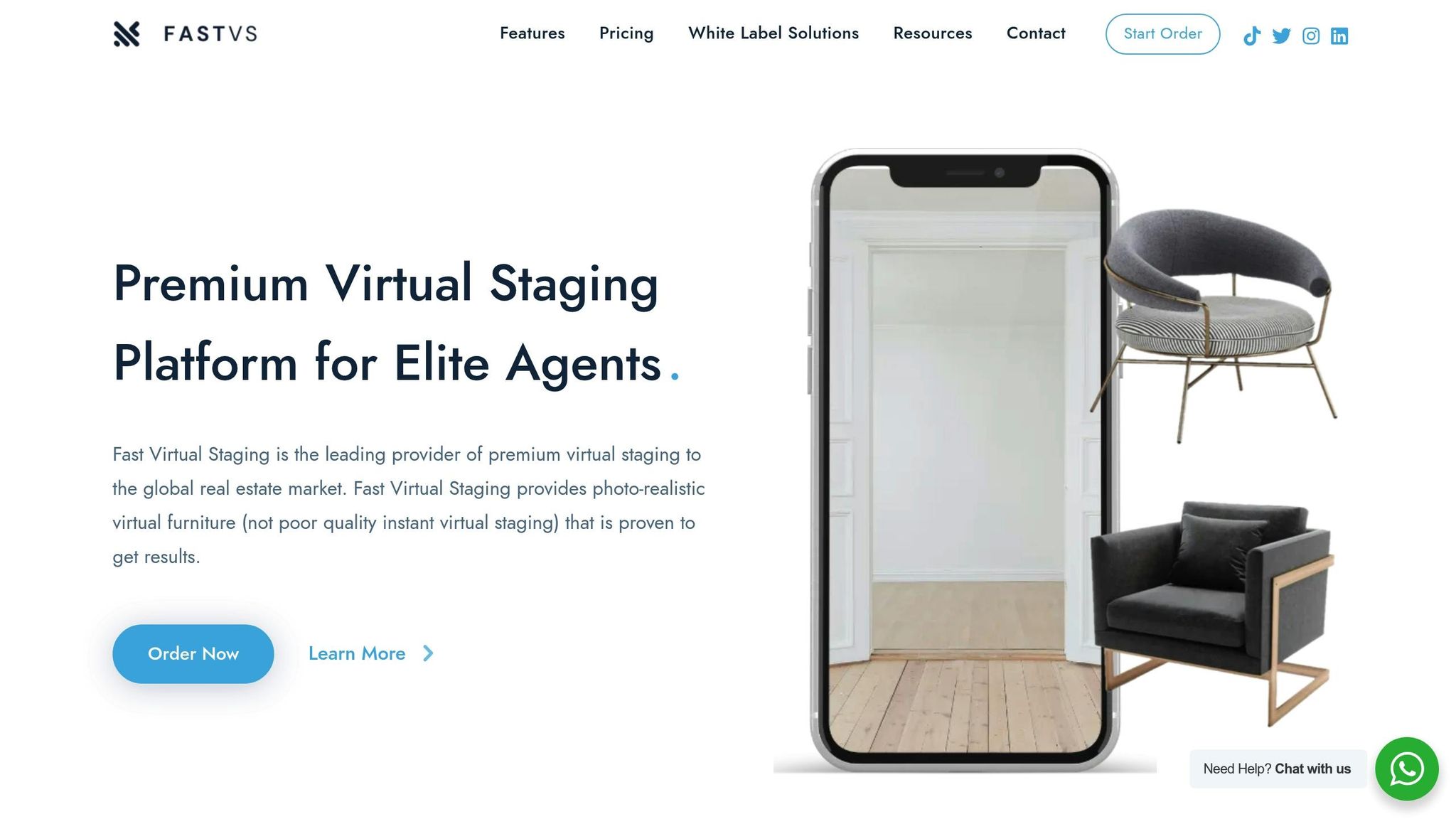
Fast Virtual Staging specializes in creating photo-realistic virtual furniture renders that seamlessly blend professional design with a natural, inviting look. These digitally staged rooms are crafted to appeal to potential buyers, offering real estate agents a powerful tool to enhance their property marketing efforts.
Fast Virtual Staging Features
Fast Virtual Staging combines speed with versatility, offering a variety of customizable features tailored to different property types. Agents can select from a broad range of interior design styles, such as:
- Modern Minimalist for sleek, contemporary condos
- Scandinavian Cozy for warm, family-friendly homes
- Industrial Chic for trendy urban lofts
- Transitional Elegance for upscale properties
- Coastal Retreat for waterfront listings
- French Country for homes with a traditional vibe
The service promises delivery within 12–24 hours, ensuring agents can keep up with fast-paced markets. Residential orders come with a guaranteed 24-hour turnaround, helping agents maintain momentum.
Additionally, the platform offers hassle-free revisions for any necessary adjustments and assigns a dedicated account manager to support clients throughout the process. Whether staging interiors or exteriors, Fast Virtual Staging delivers quality and attention to detail for both residential and commercial properties.
Pricing and How to Order
Fast Virtual Staging keeps things simple with a flat rate of $20 USD per image, making it an affordable option for agents with varying budgets. This straightforward pricing applies to all property types, eliminating confusion and making it easy to plan costs.
The ordering process is equally simple:
- Submit room photos.
- Choose a design style.
- Receive professionally staged images within 12–24 hours.
This service offers a cost-effective alternative to traditional physical staging, saving agents both time and money. For those seeking more, the platform also offers white-label solutions to enhance professional offerings.
White-Label Solutions for Real Estate Professionals
Fast Virtual Staging’s white-label program is designed for real estate photographers and agencies aiming to provide virtual staging under their own branding. These partnerships include dedicated account management and discounted pricing for white-label collaborators.
This program allows photographers and agencies to expand their services without the need for additional software or hiring design professionals. Real estate teams can integrate virtual staging seamlessly into their marketing packages, offering clients a comprehensive solution while preserving their brand identity.
White-label partners enjoy the same high-quality results and rapid turnaround times, with delivery methods that align with their existing client communication channels. This setup not only strengthens client relationships but also creates an additional revenue stream for real estate professionals.
Case Studies: Virtual Staging Results
Real estate agents across the U.S. and Canada are seeing noticeable success by weaving virtual staging into their marketing plans. The numbers don’t lie – properties sell faster, attract higher offers, and engage buyers more effectively.
Faster Sales and Better Offers
The stats tell a compelling story. Staged homes sell 73% faster, spending an average of 24 days on the market compared to 90 days for vacant properties. Even better, 85% of staged homes sell at or above their asking price . According to market data, 23% of buyer’s agents say staging boosts offers by 1% to 5%, while 68% of staged homes sell for 9% more than their unstaged counterparts .
Virtual staging also delivers an eye-popping return on investment, ranging from 500% to 3,650%. Luxury homes typically see an 8–12% price premium, mid-market homes net 5–7%, and entry-level properties gain 3–5% more on final sale prices. On average, staging generates an ROI of 586%. Beyond the financials, staging has a psychological impact: 80% of buyers are more likely to visit a staged property online, and 81% say it helps them imagine the home as their own .
Let’s dive into some real-world examples to see how these numbers translate into success.
Success Stories Across Property Types
In February 2025, a downtown condo measuring 950 square feet and listed at $865,000 underwent a virtual makeover. Designers added a loft-style sectional, warm wood textures, and dove-gray accents to create a cozy, modern vibe. The results were immediate – online views soared by 82% within 72 hours. A pre-qualified relocation buyer placed an offer 8% over asking, and the condo closed in just 12 days, shaving 55 days off the average time for urban-core properties. The seller commented that the staging made the space feel twice as large.
Another success involved a 1,650-square-foot suburban ranch home with three bedrooms and two baths, originally listed at $675,000. After sitting on the market for 60 days, feedback indicated the home felt too impersonal. The agent turned to virtual staging, updating the space with bright shaker cabinets, a kids’ play area, and a breakfast nook. The transformation worked wonders – the home went under contract in 30 days and sold for 4.5% above the relist price, just 1.2% below the original asking price. This also helped reduce the seller’s carrying costs.
In another example from 2020, Austin realtor Bob Hucker used virtual staging to enhance five listing photos and adjust the color palette shortly after the property went live on a Sunday afternoon. By Wednesday, the listing had drawn 12 showings and four offers, ultimately selling for $5,000 above the asking price. Zillow data showed the staged listing attracted roughly 1,800 views in that short window, compared to just 200 views for similar unstaged properties.
These examples highlight how virtual staging not only helps buyers visualize a property but also accelerates sales and drives up final prices. On the flip side, vacant homes tend to sell for $11,306 less on average and spend six more days on the market compared to their staged counterparts.
Conclusion: Virtual Staging as the Future of Real Estate Marketing
Virtual staging has become a game-changer for real estate agents looking to stand out in today’s competitive market. The data is compelling: homes with virtual staging sell faster, attract higher offers, and grab buyers’ attention far better than properties left unstaged.
Virtual Staging as a Competitive Edge
In an era where 96% of buyers start their home search online, listing photos are everything. They’re the digital handshake, the first impression that can make or break a buyer’s interest. Virtual staging provides agents with a powerful way to make that impression count.
Consider this: virtually staged listings get 40% more views, 31% more inquiries, and hold buyers’ attention 20% longer compared to non-staged listings. Even more striking, 73% of potential buyers will completely skip a listing if the photos feel “flat or hard to visualize”. That means unstaged properties are at risk of being overlooked by the majority of buyers.
“Selling your home is kind of like modern-day dating – you wouldn’t post a blank profile picture and expect to get matches, right? Same goes for your home. It needs to be dressed up and ready to impress. Since almost all buyers start their search online, those listing photos are your home’s first date moment. The better they look, the better your chances of catching attention.”
– Young Kim, Industry Leader at Bella Staging
Virtual staging isn’t just effective – it’s cost-efficient. It allows agents to transform empty or outdated spaces into visually stunning homes without the hefty price tag of traditional staging. This affordable solution helps listings shine in a crowded marketplace while meeting the evolving demands of today’s buyers.
Meeting Modern Buyer Expectations
The rise of HGTV and Instagram has reshaped what buyers expect when shopping for homes. Empty or outdated spaces just don’t cut it anymore. In fact, 48% of agents say buyers expect homes to look like they do on TV, while 58% report that buyers are often disappointed when homes don’t live up to these polished images.
Virtual staging bridges this gap by turning blank spaces into inviting, stylish environments that buyers can picture themselves living in. It’s no surprise that 83% of buyers’ agents say staging helps buyers visualize a property as their future home.
The shift to a digital-first buying experience has transformed how properties are marketed. As Tech Helpline puts it, “The screen is the new front door in a digital-first real estate world.” High-quality, visually engaging photos are now a must for boosting visibility on real estate platforms, where algorithms favor listings that generate more clicks and engagement.
What’s more, virtual staging offers unmatched flexibility. Agents can showcase multiple design styles – modern, minimalist, farmhouse, or classic – using the same set of photos. This versatility broadens a property’s appeal, helping it resonate with a wider range of buyers and sell faster.
With 67% of home buyers citing immersive visuals as a key factor in their decision-making, virtual staging has evolved from a nice-to-have feature to an essential tool for successful property sales. By embracing this technology, agents position themselves as leaders in a market that’s rapidly shifting toward digital-first strategies. Virtual staging doesn’t just modernize real estate marketing – it sets the tone for where the industry is headed.
FAQs
What are the cost and effectiveness differences between virtual staging and traditional staging?
Virtual staging offers a cost-effective alternative to traditional staging, with prices typically falling between $14 and $100 per image. In contrast, traditional staging can cost anywhere from $1,000 to over $5,000 per property. This price difference makes virtual staging an appealing choice for real estate agents, especially when managing multiple listings on a budget.
Beyond affordability, virtual staging is also highly efficient. Instead of physically furnishing a space, it uses digital furniture and decor to showcase a property’s potential. This approach not only saves time but also allows for greater flexibility in design. For agents aiming to create polished, eye-catching listings without the hefty price tag or logistical challenges of traditional staging, virtual staging is a smart and practical option.
How can real estate agents comply with MLS rules when using virtual staging?
Agents using virtual staging must adhere to MLS rules by clearly labeling all staged photos to prevent misunderstandings. Adding terms like "virtually staged" directly on the image or in the listing description ensures transparency for potential buyers.
Equally important, provide original, unaltered photos alongside the staged ones. This allows buyers to see the property in its actual condition. Be cautious not to misrepresent the property – structural features should remain untouched, and flaws shouldn’t be hidden.
Lastly, always double-check your local MLS guidelines to ensure your virtual staging practices align with their specific rules.
Can virtual staging match different interior design styles, and why is this important for real estate agents?
Virtual staging offers the ability to highlight a variety of interior design styles, whether it’s sleek and modern, cozy and rustic, or anything in between. This adaptability lets real estate agents present properties in ways that resonate with different buyer preferences, helping potential homeowners imagine the space as their own.
Tailoring the staging to match the tastes of the target audience can spark greater interest, build emotional connections, and even accelerate the selling process. In a competitive real estate market, it’s a smart way to make listings shine.