
Choosing between real estate photography and virtual staging depends on your property’s needs and marketing goals.
- Real estate photography captures high-quality images of a property exactly as it is. It’s ideal for showcasing move-in-ready homes or properties with modern decor.
- Virtual staging digitally adds furniture and decor to photos of empty or outdated spaces, helping buyers visualize a home’s potential. It works best for vacant properties or budget-conscious listings.
Key Takeaways:
- Professional photography is a must for accurate representation and builds trust with buyers.
- Virtual staging is cost-effective, fast, and perfect for transforming empty rooms into inviting spaces.
- Combining both can maximize a property’s appeal online and drive buyer interest.
Quick Comparison:
| Feature | Real Estate Photography | Virtual Staging |
|---|---|---|
| Cost | $230–$300 per shoot (avg.) | $39–$199 per room (one-time) |
| Timeline | 1–2 days for photos + editing | 24–48 hours after photos |
| Best For | Occupied or luxury properties | Vacant or outdated homes |
| Customization | Limited to actual decor | Multiple styles (e.g., Modern) |
| Buyer Perception | Matches in-person visits | Highlights potential design |
This article explains when to use each method, their benefits, and how combining them can help sell homes faster and at better prices.
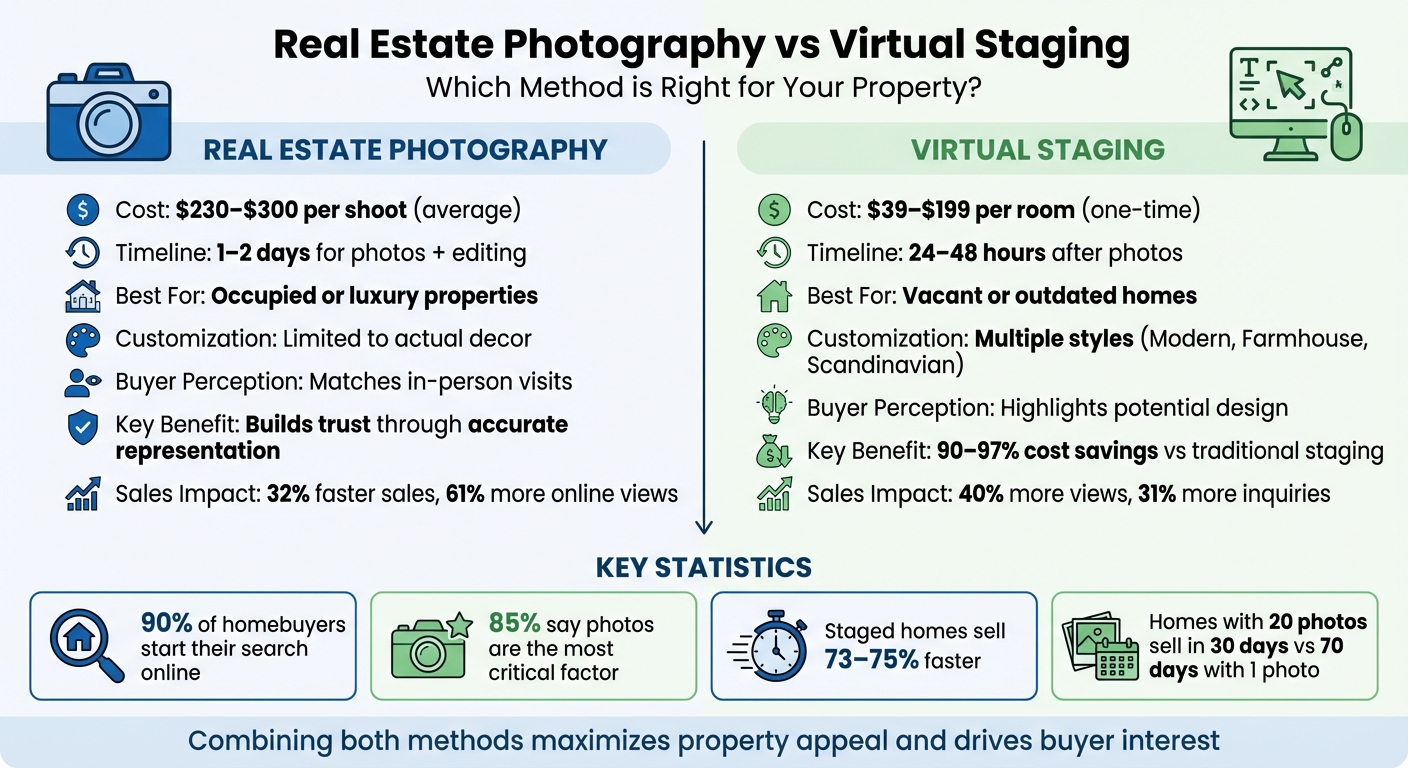
Real Estate Photography vs Virtual Staging: Cost, Timeline, and Benefits Comparison
What Is Real Estate Photography?
Real estate photography captures accurate, true-to-life images that showcase a property’s current condition and layout. Unlike virtual staging, which digitally adds elements to enhance a space, real estate photography focuses on presenting the home exactly as it appears in person.
The process typically unfolds in three steps: preparing the property, shooting with professional techniques, and editing for clarity and accurate colors. Professional photographers rely on tools like DSLR or mirrorless cameras, wide-angle lenses (16-35mm), tripods for stability, and external flashes to brighten dark areas. To maintain a natural perspective and ensure straight vertical lines, the camera is positioned at chest height during shoots.
Lighting is a game-changer in creating visually appealing photos. Many photographers prefer shooting exteriors during the "golden hour" – the hour after sunrise or before sunset – when the light is warm and inviting. For interiors, they carefully balance natural light streaming through windows with indoor lighting, often using techniques like "bracketing" (combining multiple exposures) to achieve perfectly lit images.
The results are undeniable. Homes with professional photography sell 32% faster and attract 61% more online views than those without. Considering that over 90% of homebuyers start their search online and 85% say photos are the most critical factor in deciding which homes to visit, professional photography has become a must-have for successful listings.
Key Features of Real Estate Photography
Thoughtful composition ensures balanced, spacious images. Straight vertical lines and balanced framing are essential to avoid distortion. Many photographers use tilt-shift lenses or editing tools to correct alignment issues.
Strategic lighting transforms spaces into inviting showcases. Timing is everything when it comes to capturing the best light, and the room’s orientation plays a key role:
| Room Orientation | Best Time to Shoot | Why It Works |
|---|---|---|
| East-facing rooms | Morning (8–11 a.m.) | Bright morning light with minimal contrast |
| South-facing rooms | Midday (11 a.m.–2 p.m.) | Consistent, even lighting |
| West-facing rooms | Late afternoon (3–6 p.m.) | Warm, softened light for added depth |
| Exteriors | Golden hour (sunrise/sunset) | Warm tones and an inviting glow |
Editing enhances the image without misleading. Post-processing focuses on fine-tuning lighting, straightening lines, and improving clarity. Unlike filters that could misrepresent a space, the goal is to present an accurate, polished version of the property. Modern tools, including AI, assist with tasks like sky replacement, tone adjustments, and color correction. The emphasis is always on authenticity – showcasing the property as buyers would see it in person.
These techniques come together to deliver the polished, professional results that set listings apart.
Benefits of Real Estate Photography
Professional photography builds buyer trust by offering transparency. When buyers visit a property, they see exactly what they expected based on the photos. This consistency fosters confidence and can lead to quicker decisions and stronger offers.
The boost to sales metrics is impressive. Listings with professional photos generate 118% more online views compared to those with lower-quality images. Beyond visibility, well-photographed properties can sell for up to 47% higher prices. Homes with 20 photos often sell within 30 days, while those with just one photo can linger on the market for 70 days.
"Eighty-five percent of those buyers say it’s the photos that are the most important factor in deciding which homes to go view." – Krisztina Bell, Professional Home Stager, Virtually Staging Properties Inc.
High-quality photos fit seamlessly into all marketing efforts. These images can be used across the MLS, social media platforms like Instagram and Pinterest, print ads, and dedicated property websites. A single photo shoot can fuel an entire marketing campaign, maximizing the return on investment.
A competitive edge in the market. Only 35% of real estate agents currently use professional photographers, meaning listings with professional images immediately stand out. In a world where buyers often judge a property based on its thumbnail photo, professional photography can make all the difference between catching a buyer’s eye or being overlooked.
While real estate photography highlights a property’s current state with precision, virtual staging takes things a step further by digitally enhancing its appeal – more on that next.
What Is Virtual Staging?
Virtual staging uses digital tools to add lifelike furniture, décor, and design elements to property photos. Instead of physically furnishing a space, designers digitally enhance images to transform empty rooms into warm, inviting spaces. This makes it easier for buyers to picture a property’s potential, much like professional photography enhances a listing’s appeal.
Beyond just furniture, virtual staging can declutter rooms or simulate renovations by modifying flooring, wall colors, and fixtures – all without any physical changes. This makes it especially useful for vacant homes, older properties, tenant-occupied listings, or new construction projects where buyers need to see a polished interior before completion.
"Selling your home is kind of like modern-day dating – you wouldn’t post a blank profile picture and expect to get matches, right?"
- Young Kim, Industry Leader, Bella Staging
Staged homes tend to sell 73–75% faster than unstaged ones, and about 85% of staged homes meet or exceed the asking price. With over 90% of buyers starting their home search online, that first impression is everything.
How Virtual Staging Works
The process of virtual staging typically involves four steps. First, high-quality photos of the vacant or outdated space are taken. Next, a design style – like Modern, Farmhouse, or Scandinavian – is selected. Then, experts or AI tools digitally insert 3D furniture and décor, carefully adjusting for scale, lighting, and perspective. Finally, the completed images are delivered, often within 24 to 48 hours.
Technology has significantly improved virtual staging. Advanced platforms now use AI for floor plan recognition and automated lighting adjustments. Some even offer 360° staging, creating panoramic views that integrate seamlessly with virtual tour systems like Matterport or iGuide.
Living rooms are the most commonly staged spaces, accounting for about 33% of orders, followed by bedrooms at 31%. Home offices and outdoor areas each make up 16%, reflecting both the rise of remote work and the growing interest in outdoor living spaces.
This efficient process not only speeds up marketing efforts but also provides a range of practical benefits.
Benefits of Virtual Staging
It’s surprisingly affordable. Virtual staging costs between $24 and $199 per room as a one-time expense, with some AI-powered services charging as little as $0.28 per image. Compare this to traditional staging, which typically includes a $300–$600 consultation fee plus $500–$600 per room per month under multi-month contracts. Virtual staging can save you 90–97% of the cost.
It offers unmatched flexibility. A single space can be staged in multiple styles – Modern for young professionals, Farmhouse for families, or Scandinavian for those who love simplicity. Changes are quick and easy, unlike physical staging, which is limited by available furniture and logistics. Keeping the property empty also avoids concerns about furniture maintenance or damage.
"Some people walk in an empty house and that’s all they see – an empty house – and they can’t picture what it would look like staged, so this helps a lot."
- Farrell Desselle, Listing Coordinator, Redfin Realty
Virtual staging also boosts buyer interest. Listings with virtually staged images receive about 40% more views and 31% more inquiries than those without. Plus, 81% of buyer agents say staging helps buyers imagine themselves living in the home, making it a powerful marketing tool [7, 21].
Transparency is key. Always disclose that images have been virtually staged – either in the listing description or with a watermark. Showing both the original and staged photos helps buyers understand the property’s true scale and potential.
Real Estate Photography vs. Virtual Staging: Key Differences
Let’s dive into how real estate photography and virtual staging differ in their approach and the impression they leave on potential buyers.
Both methods aim to present properties in the best possible light online, but they achieve this in very different ways. Real estate photography captures the property as it is, focusing on its current condition. This requires a hands-on process: cleaning, decluttering, and sometimes traditional staging. Photographers visit the property equipped with cameras, wide-angle lenses, tripods, and lighting gear to document every detail.
Virtual staging, on the other hand, happens entirely after the photos are taken. Designers use advanced software and 3D tools to digitally add furniture and décor to empty or outdated spaces. No physical setup is required – just a digital makeover that transforms bare rooms into inviting spaces. This difference in execution highlights their contrasting roles in shaping buyer perceptions.
Photography provides a realistic snapshot, showcasing the property’s natural layout, lighting, and architectural features. Virtual staging, however, focuses on reimagining what a space could become, especially useful for vacant homes or those needing a design refresh.
"Virtual staging wins the online attention battle."
- Victor Coll, Seasoned Expert
One of the most striking differences lies in flexibility. Traditional staging locks in a single look, while virtual staging offers endless possibilities. A single room can be styled in multiple ways – modern, farmhouse, Scandinavian, or more – all without moving a single piece of furniture.
Comparison Table
Here’s a quick side-by-side look at how the two methods stack up:
| Feature | Real Estate Photography | Virtual Staging |
|---|---|---|
| Cost | Varies by photographer; traditional staging can range from $500–$2,000+ per room | $39–$199 per room (one-time) |
| Timeline | Days to weeks (scheduling, setup, shoot, editing) | 24–48 hours after photos are taken |
| Physical Requirements | Requires on-site presence, cleaning, and staging | None – done remotely using existing photos |
| Customization | Limited by available furniture and staging elements | Virtually unlimited styles and designs |
| Buyer Perception | Offers a realistic view matching in-person visits | Creates visually appealing online listings but may differ in person |
| Best For | Luxury homes or occupied properties needing accurate representation | Vacant homes, budget-conscious listings, or quick turnarounds |
Cost Comparison
When it comes to pricing, real estate photography and virtual staging follow different models. Photography is usually priced as a package for the entire property, while virtual staging charges are based on the number of rooms or images. Let’s break down the costs to help with budgeting.
For a standard photoshoot (10–25 photos), the average cost nationwide is about $230, with regional variations – $318 in Los Angeles and $208 in Phoenix. Tony Mariotti, CEO of RubyHome, explains:
"A new photographer with little or no experience may set a fee as low as $60-$100. With any experience, most professional photographers charge between $110-$300 per project for photos only".
On the other hand, virtual staging costs range from $39 to $199 per room. This is significantly less expensive than traditional physical staging, which often starts at $500–$800 per month for basic setups. Devon Higgins, CMO at PhotoUp, highlights the savings:
"Virtual staging is much more cost effective than traditional staging (as in, 60-90% less expensive)".
For a typical home, digitally staging 4–5 key rooms might cost around $150 total, which is a fraction of the cost of renting furniture for physical staging.
Additional services like drone photography, 3D virtual tours, and videos can increase photography expenses. However, these add-ons often pay off. For instance, listings with aerial drone shots experience a 68% higher chance of selling, making them a worthwhile investment for many properties.
In essence, photography provides a one-time visual representation of a property, while virtual staging offers a cost-effective way to digitally furnish spaces. As one real estate agent puts it:
"A $500 one-time fee to virtually stage an entire home is definitely more appealing to the Realtor if we are covering the cost, but also the seller if they’re covering it".
Timeline and Speed
When it comes to launching a property listing, timing is everything. The quicker you can present an appealing listing to potential buyers, the better. Traditional real estate photography involves several steps – scheduling, on-site shooting (which can take 1 to 4 hours), and editing. Typically, this process takes 24–48 hours, though unforeseen issues like bad weather or last-minute changes can cause delays.
Virtual staging, on the other hand, bypasses many of these challenges. With photos in hand, AI-powered virtual staging can produce staged images in under 30 seconds. Services like Fast Virtual Staging promise a 24-hour turnaround for residential properties, delivering highly detailed, furnished images without worrying about moving furniture or weather-related disruptions.
Victor Coll, a content marketing expert at Hometrack, highlights the convenience:
"Virtual staging takes hours – sometimes minutes… [it] removes all those obstacles [like weather or furniture delivery]".
The difference in speed is striking. If a particular design style doesn’t resonate, virtual staging allows for quick adjustments, with new images ready in hours. Compare this to physical staging, which can take days or even weeks to rework.
For agents under tight deadlines, blending both approaches can be a smart strategy. Seth Greenwell, Senior Manager at ShowingTime+, outlines a common workflow: "One day to turn the photos and one day to virtually stage". By understanding these timeline nuances, agents can plan effectively to maximize their listing’s impact in the market.
sbb-itb-7eef225
Impact on Online Listings and Buyer Interest
When it comes to online real estate listings, you’ve got just 7 seconds to grab a buyer’s attention. That’s not much time, so every visual element has to work hard to make an impact.
Professional photography makes a big difference. Research shows that 66% of buyers – and nearly 90% of younger buyers (ages 34–43) – consider photos the most important feature when searching for homes online. Homes photographed with professional DSLR cameras tend to sell for $3,400 to $11,200 more than those with amateur images. Even more impressive, homes with high-quality photos sell at or above the listing price 44% of the time, compared to just 13% for homes with average photos. While great photography builds trust, staging takes it a step further by creating an emotional connection.
Virtual staging can take this to another level. For vacant or outdated spaces, virtual staging enhances the appeal and draws more attention. Listings with virtually staged photos get 40% more views and 31% more inquiries. On top of that, buyers spend 20% more time looking at virtually staged images, which increases their engagement.
"If you have an empty house showing a living space that’s virtually or physically staged, you’re going to get the buyer to slow down and see a very beautiful interior, enticing them to schedule a showing."
- Seth Greenwell, Senior Manager, ShowingTime+
Combining professional photography with immersive tools like virtual staging can significantly boost performance. Listings with these features see 75% more page views, saves, and shares. More importantly, 81% of buyers and renters say staging helps them picture a property as their future home. And with 49% of buyers in 2024 feeling confident enough to make offers based solely on virtual tours, it’s clear that high-quality online presentation doesn’t just attract clicks – it drives serious interest and stronger offers.
When to Use Each Method
Deciding between professional photography and virtual staging depends on factors like the property’s condition, your budget, and how quickly you need to market the listing.
For vacant properties, virtual staging is often the go-to solution. Empty rooms can feel uninviting and smaller than they actually are, which makes it tough for buyers to imagine how the space could work for them. Virtual staging solves this by digitally adding furniture and decor, helping to showcase the room’s size and functionality. Real estate agent Georgina Jacobson of Coldwell Banker puts it this way:
"Virtual staging is a cost-effective method for staging a property and has become increasingly popular in markets where homes are selling quickly".
On the other hand, if the home is move-in ready and already features modern decor, professional photography might be all you need. High-end properties – especially those priced above $1,000,000 – often benefit from showcasing their real, tangible features during in-person tours. But for homes that are partially furnished or have outdated interiors, virtual staging can still be a smart choice. Devon Higgins, CMO at PhotoUp, highlights this distinction:
"For listings under $1,000,000, virtual staging is typically optimal".
Budget and timing also play a huge role. Physical staging can be expensive and takes time to arrange, whereas virtual staging is far more affordable – cutting costs by up to 97% – and can be completed within 24–48 hours. This makes virtual staging an appealing option when physical staging isn’t practical.
For homes with outdated or cluttered interiors, virtual staging offers another advantage: it can digitally remove old furniture and refresh the design to match popular styles like Modern, Farmhouse, or Scandinavian. This flexibility helps attract a broader range of potential buyers by presenting the home in its best light.
Using Both Methods Together
When it comes to showcasing properties, the best approach often isn’t choosing between professional photography and virtual staging – it’s combining the strengths of both. Professional photography captures a home’s true essence, while virtual staging reimagines its possibilities. Together, they create a well-rounded presentation that appeals to buyers on multiple levels.
Professional photography highlights the real-world lighting, dimensions, and layout of a property. On the other hand, virtual staging adds digital furniture and decor, helping potential buyers picture how the space could look when fully furnished. This is especially effective for vacant homes. The photographs provide a clear sense of scale, while staged images offer a vision of how the space might be used. According to a survey, 81% of buyers’ agents believe staging helps buyers visualize a property as their future home.
Felicia Captain, a real estate agent with Coldwell Banker Realty, emphasizes the value of blending these methods:
"Having large photo canvases of the virtually staged rooms is helpful, so the prospective buyer sees the virtual staging in a larger format while standing in the space".
This approach bridges the gap between what buyers see online and what they experience during in-person visits, making it easier for them to connect the dots between an empty room and its potential.
To maximize impact, focus on key areas of the home. Living rooms and bedrooms are the most commonly staged spaces, with 33% and 31% of virtual staging orders targeting these rooms, respectively. By pairing high-quality professional photos with strategically staged images of these spaces, you can create a marketing package that works across all platforms – from online listings to printed materials – without breaking the bank. For instance, Fast Virtual Staging offers a cost-effective solution, delivering staged images for $20 each within 12–24 hours.
Finally, transparency is key. Always disclose virtually staged images with a watermark or note to maintain trust with potential buyers. Clear communication ensures buyers feel confident in what they’re seeing, setting the stage for a positive experience.
Conclusion
Real estate photography and virtual staging each play unique yet complementary roles in property marketing. Photography captures the true essence of a home – its layout, natural lighting, and architectural features – while virtual staging breathes life into empty or outdated spaces by digitally adding furniture and decor. When used together, these tools can significantly enhance your online listings and help potential buyers establish a connection with the property.
For vacant homes or quick sales, virtual staging offers an affordable and efficient solution, costing just $20 per image. On the other hand, high-end or luxury listings often benefit more from authentic, high-quality photography. In many cases, combining both strategies can create a well-rounded marketing approach that not only builds trust but also helps buyers visualize themselves living in the space.
The numbers speak for themselves: staged homes attract more views, sell faster, and engage buyers more effectively. These results highlight the importance of investing in strong visuals to make a lasting impression.
Fast Virtual Staging simplifies the process by providing highly realistic digital furniture renders with a 24-hour turnaround. At only $20 per image, this service includes hassle-free revisions and customizable design styles, making it easy to transform vacant properties into inviting, buyer-ready homes.
Ultimately, the choice between photography, virtual staging, or a combination of both depends on your property’s condition and your marketing objectives. Whichever route you take, always ensure full disclosure of any digital enhancements to maintain transparency and buyer confidence.
FAQs
How does virtual staging make a property more appealing compared to standard real estate photography?
Virtual staging takes empty or sparsely furnished rooms and transforms them into inviting, well-designed spaces. By digitally adding furniture, décor, and lighting to high-quality photos, it helps buyers visualize the property as a cozy, livable home. This technique creates an atmosphere that draws attention and piques interest.
Unlike traditional real estate photography, which simply presents the property as it is, virtual staging offers a flexible and affordable way to highlight a home’s potential. The result? More eye-catching listings, increased online engagement, higher inquiry rates, and often quicker offers.
How do the costs of real estate photography compare to virtual staging?
Real estate photography often comes with a higher price tag compared to virtual staging. Photographers typically charge several hundred dollars per property, with costs influenced by factors like their expertise, location, and the scope of services included. These fees reflect the time and effort needed to produce high-quality images that showcase the property as it is.
On the other hand, virtual staging is generally priced per room and tends to be a more budget-friendly alternative. For instance, staging a 500-square-foot room digitally might cost between $250 and $350, making it a practical option for enhancing a property’s online presence. While both methods have their strengths, virtual staging often stands out as the more economical choice for creating visually appealing digital listings.
When should you use real estate photography and virtual staging together?
Using real estate photography alongside virtual staging creates a powerful combination for showcasing a property. Start by taking high-quality photos of the empty or sparsely furnished space. These images provide a clear, accurate view of the home’s layout, natural lighting, and architectural details. Then, use virtual staging to digitally add furniture and décor, giving potential buyers a glimpse of how the space could look once fully styled.
This method is especially helpful for vacant homes, minimally furnished properties, or listings with tight staging budgets. It blends the reliability of real photos with the visual charm of staged interiors, making online listings more appealing while still presenting realistic expectations for in-person tours or open houses. In the U.S., where most buyers begin their search online, professionally staged photos can make a listing stand out and generate more interest.