
Want to sell a home faster and attract more buyers? It all starts with the right photos. By 2025, two main methods dominate real estate marketing: standard photography and digital staging. Each has its strengths, costs, and best use cases.
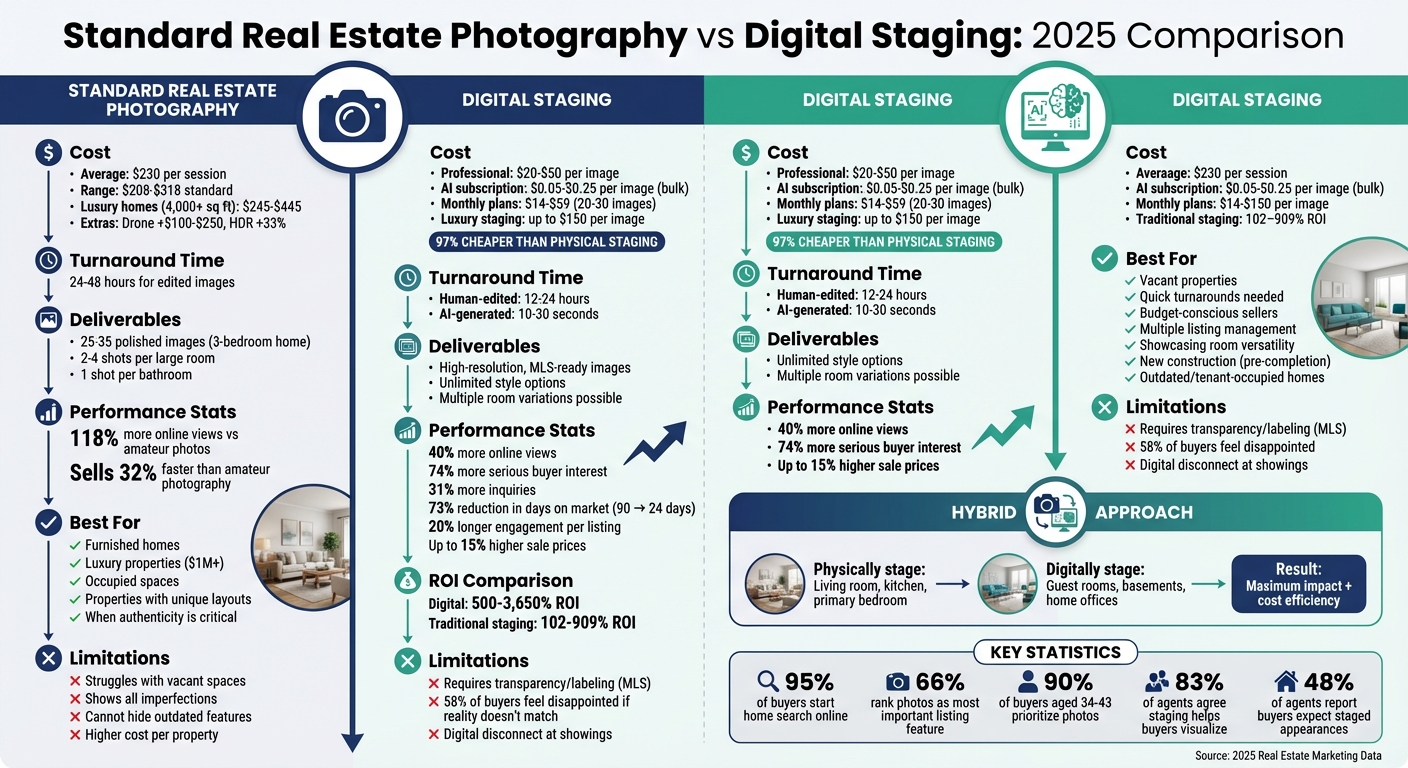
- Standard Photography: Shows the property as it is – ideal for furnished homes or luxury listings. Costs average $230 per session, with 25–35 polished images delivered in 24–48 hours. However, it struggles with vacant or outdated spaces.
- Digital Staging: Uses AI to add furniture and decor to empty rooms. It’s faster and cheaper, costing $20–$50 per image with results in 12–24 hours. Perfect for vacant properties, quick turnarounds, and showcasing multiple styles.
Quick Comparison:
| Method | Average Cost | Turnaround Time | Best For |
|---|---|---|---|
| Standard Photography | $230 per session | 24–48 hours | Furnished homes, luxury listings |
| Digital Staging | $20–$50 per image | 12–24 hours | Vacant spaces, modern updates |
Both methods help listings stand out online, but choosing the right one – or combining them – depends on the property and budget. A smart visual strategy can make the difference between a home that lingers and one that sells quickly.
Standard Real Estate Photography vs Digital Staging: Cost, Speed & ROI Comparison 2025
Turning Vacant Properties Into Staged Photos & Video
sbb-itb-7eef225
Standard Real Estate Photography: What It Is and How It Works
Standard real estate photography focuses on showcasing a property just as it is – whether it’s fully furnished or completely empty. To prepare, agents go through a process of deep cleaning and decluttering, ensuring the space feels neutral and inviting. They check light bulbs to ensure consistent lighting, open curtains to let in natural light, and adjust mirrors to avoid distracting reflections.
What Standard Real Estate Photography Includes
Professional photographers rely on high-quality DSLR or mirrorless cameras paired with wide-angle lenses (16–35 mm) to capture the space effectively. Timing is everything: east-facing rooms are best photographed in the morning (8:00 a.m.–11:00 a.m.), west-facing ones in the late afternoon (3:00 p.m.–6:00 p.m.), and exterior shots shine during the golden hour. Post-production is where the magic happens, refining images to bring out the best in both interiors and exteriors.
For a typical 3-bedroom home, photographers deliver 25–35 polished images. Larger rooms like living areas and bedrooms usually get 2–4 shots each, while smaller spaces, such as bathrooms, might only need one photo. These professional images make a huge difference: listings with high-quality photos get 118% more online views and sell 32% faster compared to those with amateur pictures [17, 18]. This meticulous process highlights why professional photography is a worthwhile investment for real estate agents and sellers.
Costs, Timeline, and When to Use It
With all the preparation and expertise involved, pricing reflects the value of professional photography. In 2025, the average cost for a photography package is about $230 nationwide, though the actual price can vary depending on the property’s size and location [16, 17]. Standard shoots typically range between $208 and $318, while larger homes – like luxury properties over 4,000 square feet in states like Florida – can cost between $245 and $445. Extras, such as drone photography, often add $100–$250, and HDR processing can increase the base price by roughly 33% [15, 17]. Turnaround time is quick, with most photographers delivering edited images within 24–48 hours.
This approach works particularly well for homes that are already furnished and decorated, as it captures the space in its best light. It’s especially effective for luxury properties, where buyers expect to see the actual layout and design during in-person tours. By presenting the home as it is, traditional photography builds trust, ensuring potential buyers see an accurate representation of what they’ll experience during a showing. As Matterport puts it:
A listing without traditional real estate photography is like a book without a cover.
Where Traditional Photography Falls Short
While traditional photography is great for occupied and well-furnished homes, it struggles with vacant properties. Empty rooms can feel cold and uninviting, making it hard for buyers to imagine how the space could look when staged. As Farrell Desselle from Redfin explains:
Some people walk in an empty house and that’s all they see – an empty house – and they can’t picture what it would look like staged.
Another drawback is that traditional photography captures everything, including imperfections like outdated wallpaper, worn carpets, or old fixtures. Without investing in physical renovations or staging, it can be challenging to showcase the home’s potential.
Digital Staging: How Technology Changes Property Marketing
Digital staging is revolutionizing the way properties are marketed, offering a sleek alternative to traditional photography. Instead of physically moving furniture into a home, this method uses software to digitally add furniture, decor, and lighting to photos of empty rooms. The result? Potential buyers browsing online can see a fully furnished space, helping them picture themselves living there – without anyone lifting a single chair.
The Digital Staging Process
The process begins with high-quality photos of the vacant property. Photographers capture images at eye level (around 4.5–5 feet) using either a DSLR camera or a modern smartphone, ensuring vertical lines stay straight to preserve the room’s proportions. If the room is cluttered or outdated, digital tools can remove furniture and mess before the staging begins.
Once the photos are ready, agents upload them to a digital staging platform, specify the type of room, and select a design style – such as Modern, Scandinavian, or Farmhouse. Using advanced AI, the platform analyzes the room’s geometry, lighting, and shadows to place 3D furniture that looks natural and proportional. After the initial render, agents can make adjustments, swap furniture, or tweak layouts using simple drag-and-drop tools, resulting in high-resolution, MLS-ready images.
By 2025, many platforms deliver staged images in seconds, while high-end services offer designer-led staging for luxury properties that require ultra-realistic finishes. Some tools even let agents describe a desired look, and AI generates a matching design. Others take it further, creating cinematic social media videos from a single staged image.
Lower Costs and Faster Delivery
Digital staging solves the cost and logistical headaches of traditional staging. Physical staging typically costs between $1,500 and $4,000 for the first month, plus additional rental fees. In contrast, digital staging comes in at a fraction of the price, with professional human-edited services costing $20–$50 per image. Subscription-based AI tools can reduce costs even further, with prices as low as $0.05 to $0.25 per image for high-volume plans.
Time is another advantage. While physical staging can take days or even weeks, digital staging delivers results in as little as 12–24 hours for human-edited images and just 10–30 seconds for AI-generated versions. Companies like Fast Virtual Staging guarantee 24-hour delivery on residential orders, charging only $20 per image [fastvirtualstaging.com].
Design Options and Flexibility
Flexibility is where digital staging truly shines. Unlike physical staging, which locks you into one furniture style for the entire listing period, digital staging allows agents to restage a room multiple times without requiring a new photo shoot. For example, a spare bedroom can be shown as both a nursery and a home office to attract different types of buyers. This adaptability is especially helpful for agents juggling multiple listings, as they can stage properties without worrying about furniture availability or delivery logistics.
Agents can also explore countless design styles and make unlimited revisions. In 2025, some of the most popular styles include Transitional (26.3%), Modern (19.1%), Farmhouse (13.5%), and Traditional (10%). Some platforms now even offer "shoppable staging", where buyers can purchase the exact furniture shown in the staged photos through embedded links. Achieving this level of customization with traditional staging would be nearly impossible – or wildly expensive.
Transparency is essential, though. Most MLS systems require virtually staged photos to be clearly labeled to ensure buyers know what to expect during in-person viewings. Seth Greenwell from ShowingTime+ puts it well:
Virtual staging is like a magic wand in which buyers can walk through that vacant space and see no furniture, but they can pull up their phone and see virtually staged rooms with a virtual reference point.
These advancements set the stage for a closer look at costs and return on investment in the next section.
Cost Comparison and ROI: Traditional Photography vs Digital Staging
Cost Breakdown and Potential Savings
When it comes to costs, traditional staging is significantly pricier than digital staging. As of 2025, the median cost for physical staging has risen to $1,500 – up from $400 in 2019. Depending on the package, prices range between $1,500 and $4,000 for the first month, with additional monthly rental fees if the property doesn’t sell quickly. On the other hand, digital staging is far more affordable, costing between $20 and $50 per professionally edited image. For example, Fast Virtual Staging charges $20 per image with a guaranteed 24-hour turnaround for residential orders. Even high-end luxury digital staging maxes out at around $150 per photo – still more than 90% cheaper than traditional staging.
| Method | Average Cost | Turnaround Time | Flexibility |
|---|---|---|---|
| Traditional Staging | $1,500–$4,000+ (first month) | Days to weeks | Limited to rented furniture |
| Digital Staging | $20–$50 per image | 12–24 hours (or seconds with AI) | Unlimited styles and layouts |
Brian Pearl, a leading real estate agent in South Florida, sums it up perfectly:
"It’s all about the price; virtual staging offers a huge financial benefit that can literally save you thousands of dollars".
These savings create a clear advantage, especially when considering market performance.
ROI and Market Performance
The return on investment (ROI) for digital staging is impressive, ranging from 500% to 3,650%, compared to 102% to 909% for traditional staging. Virtually staged listings tend to attract 74% more serious buyer interest, generate 40% more online views, and receive 31% more inquiries compared to unstaged listings. This stark difference is largely due to the lower upfront costs – spending $20 per image instead of investing $1,500 makes a huge impact on efficiency.
Additionally, digital staging shortens the time properties spend on the market by 73%, reducing the average listing period from 90 days to just 24 days. Staged homes, in general, sell roughly three times faster and can achieve up to 15% higher sale prices.
Interestingly, the effectiveness of traditional staging has declined over the years. In 2017, 39% of agents reported that traditional staging reduced days on the market, but by 2025, that figure had dropped to 19%. Meanwhile, 83% of buyer’s agents agree that staging – especially virtual – helps buyers better visualize a property as their future home.
These strong ROI figures highlight the scalability and efficiency that digital staging brings to the table.
Scaling Your Marketing Efforts
The real magic of digital staging lies in its scalability. Traditional staging comes with logistical headaches – furniture rentals, deliveries, and setups for each property – that quickly add up when managing multiple listings. Digital staging eliminates these challenges, allowing agents to stage multiple properties simultaneously. Whether you’re staging one room or fifty, the cost remains consistent at around $20 per image, making it easier to cater to a wide range of buyer preferences.
For agents and brokerages handling high volumes, subscription plans make digital staging even more attractive. Monthly packages, typically priced between $14 and $59 for 20–30 images, and AI-powered tools costing $20 to $100+ per month, enable agents to maintain a polished, professional look across all their listings.
Victor Coll, a content marketing expert at Hometrack, puts it this way:
"Virtual staging works better for most listings because it delivers modern, polished visuals at a fraction of the cost and time of traditional staging".
How Buyers Respond to Different Visual Marketing Methods
Online Views and Engagement Numbers
Virtually staged listings tend to grab more attention, pulling in 40% more views and keeping buyers engaged for 20% longer per listing. These listings don’t just attract more clicks – they bring in higher-quality leads. In fact, one study revealed that virtually staged properties generate more serious interest from potential buyers.
When it comes to online searches, photography is a dealbreaker. A whopping 66% of homebuyers – and up to 90% of those aged 34 to 43 – rank photos as the most important feature on a real estate website. Modern buyers have high expectations, often influenced by the polished visuals on home renovation shows. Nearly 48% of agents report that buyers now expect professionally staged appearances.
Managing Buyer Expectations
While virtual staging boosts views and inquiries, it also creates a challenge: managing buyer expectations. About 58% of buyers feel disappointed when a property doesn’t live up to the high standards set by its online images. To avoid this, transparency is key. Virtually staged images should be clearly labeled with watermarks, and original photos should be included to provide a realistic perspective. As Katy Borja, Director of Marketing at Dickson Realty, emphasizes:
"The key there is transparency and making sure the photos are labeled as AI staging, versus what a house really looks like, so that buyers aren’t feeling duped".
It’s also important not to use digital staging to hide flaws or misrepresent the property. For instance, altering room dimensions or covering up defects can mislead buyers and damage trust. Digital renderings should reflect the property’s actual layout, and the furniture used in staging should align with the home’s style to ensure a cohesive look. Maintaining this balance helps keep the online images aligned with the real-life experience.
The In-Person Showing Experience
The real test for digital staging comes when buyers step into the actual space – what some call the "digital disconnect". While 31% of buyers are more likely to visit a property in person after viewing it online with virtual staging, their enthusiasm can wane if the real-life experience doesn’t match the online promise. Bridging this gap is essential to building buyer confidence.
To address this, agents are finding creative ways to connect the dots between digital renderings and the physical space. Real estate agent Brian Pearl suggests:
"Display enlarged photos on art boards and put them in the actual room in the house so people can see ‘Oh, this is the room I saw the picture of, and this is how it’s going to look’".
Using iPads or printed boards to showcase virtually staged images during showings can help buyers visualize the space as they saw it online. Felicia Pulley, Creative Director at the Real Estate Staging Association, underscores the importance of in-person experiences:
"The in-person experience still does the heavy lifting when it comes to offers".
When to Use Each Method
When Traditional Photography Works Best
Traditional photography is ideal for showcasing luxury properties where buyers expect to see a polished, move-in-ready experience during in-person tours. High-end buyers often look for homes that exude authenticity and sophistication, and physical staging meets these expectations perfectly. For homes priced at $1 million or more, spending $1,500 to $4,000 on traditional staging for the first month fits seamlessly into the marketing budget.
Occupied homes are another great match for traditional photography. If the home is already furnished and only needs minor decluttering or soft staging, traditional photography effectively captures its charm without requiring digital enhancements. Homes with unusual or tricky layouts also benefit from this approach, as physical staging helps buyers grasp how to navigate and utilize the space during tours.
When Digital Staging Is the Better Choice
Digital staging steps in when traditional photography has its limitations, offering distinct advantages in certain situations. It’s particularly effective for vacant properties, where empty rooms can look smaller in photos, making it hard for buyers to gauge their size and purpose. Farrell Desselle, Listing Coordinator at Redfin, highlights this benefit:
Some people walk in an empty house and that’s all they see – an empty house – and they can’t picture what it would look like staged, so this helps a lot.
Speed is another major perk of digital staging. With turnaround times as quick as 4 to 48 hours, it’s much faster than traditional methods. New construction projects also benefit since digital staging allows you to showcase completed spaces even before the construction wraps up.
Homes with outdated furniture or those that are tenant-occupied are also prime candidates for digital staging. Instead of rearranging or replacing dated decor, digital staging offers modern, stylish updates. It’s also great for showing versatility – like transforming a spare room into a nursery in one image and a home office in another. As real estate agent Kim Daneault notes:
Spaces with an odd shape or no defined purpose can really benefit from staging; it helps buyers see the area as an asset instead of a waste of space.
Using Both Methods Together
Sometimes, combining both traditional and digital staging creates the best results. A hybrid strategy allows agents to maximize the strengths of each method. For example, physically staging key rooms like the living room, kitchen, and primary bedroom can make a strong impression, while digitally staging secondary spaces – such as guest rooms, basements, or home offices – saves time and resources.
Services like Fast Virtual Staging make this approach even more accessible, offering photo-realistic renders with a 24-hour turnaround for just $20 per image. This combination of methods meets the demands of modern real estate marketing, delivering both efficiency and visual appeal in one package.
Conclusion
Traditional real estate photography and digital staging each bring their own strengths to property marketing. Traditional photography shines when it comes to showcasing properties as they truly are. It captures architectural details and natural lighting that buyers value during in-person showings. This approach is often the go-to for luxury properties, where buyers expect to see polished, move-in-ready spaces.
On the other hand, digital staging addresses the challenges of empty or poorly furnished spaces. It’s incredibly cost-effective – up to 97% cheaper than physical staging – and offers quick turnaround times, often within 24 hours. Plus, its flexibility allows for unlimited design options. With 95% of buyers starting their home search online and 66% considering photos the most important part of a listing, digitally staged images significantly boost online engagement.
For the best results, many real estate professionals combine the two methods. Physically staging key areas like the living room, kitchen, and primary bedroom creates a strong emotional connection during showings. Meanwhile, digitally staging secondary spaces – such as guest rooms or basements – keeps costs in check. Services like Fast Virtual Staging, for instance, offer photo-realistic renders starting at just $20 per image, delivered in 24 hours.
The choice between these methods depends on factors like property type, budget, and timeline. For high-end homes where in-person impressions are critical, traditional staging can make a big difference. For vacant properties or situations requiring a quick, budget-friendly solution, digital staging offers excellent value. And when you want to maximize impact across both online and offline channels, combining these approaches gives you a clear competitive advantage.
Whatever method you choose, transparency is key. Disclosing digitally staged images, as required by MLS guidelines, helps maintain buyer trust. When used strategically, these tools not only help properties sell faster – up to 73% faster – but can also increase sale prices by 1% to 5%.
FAQs
How does digital staging influence buyers compared to traditional real estate photography?
Digital staging can completely change how buyers view a property by presenting it in a more modern, welcoming, and visually appealing way. Unlike traditional photos that show a home exactly as it is, digital staging takes it a step further – it adds furniture, decor, and even adjusts lighting to help buyers picture the space’s full potential. This can be especially helpful for empty or outdated rooms that might otherwise feel cold or uninspiring.
Homes with digitally staged images tend to grab more attention online, which often leads to higher engagement and quicker sales. By tackling common issues like bare spaces or dim lighting, digital staging provides an affordable and flexible way to showcase a property’s strengths and help it stand out in a crowded market.
What are the cost and time advantages of digital staging compared to traditional home staging?
Digital staging is a game-changer when it comes to saving both time and money. It can slash costs by up to 97% compared to traditional staging, mainly because there’s no need to rent physical furniture or hire labor. Plus, it’s incredibly fast – most digital staging projects are completed in just 24 to 48 hours, whereas traditional staging can take anywhere from 7 to 14 days.
This makes digital staging a smart and efficient way to showcase properties without compromising on style or quality.
When should you use both traditional photography and digital staging for real estate listings?
Combining classic photography with digital staging works wonders during the online marketing phase of a property listing. While high-quality photos showcase the property’s genuine features, digital staging takes it a step further by illustrating how the space could look when furnished or tailored to suit a buyer’s style.
This approach is especially useful for vacant homes, properties with older furniture, or listings aiming to attract a wider audience. It enhances visual appeal, grabs attention, and often helps properties sell quicker by making them feel more inviting and relevant to potential buyers scrolling through online listings.