
Virtual furniture is transforming real estate marketing. It’s faster, cheaper, and more effective than traditional staging. Homes with virtual staging sell 73% faster, get 40% more views, and attract 31% more inquiries. In 2025, cutting-edge AI tools make staged photos highly realistic, while AR allows buyers to interact with spaces in real time. Costs are slashed – starting at $10 per room compared to thousands for physical staging – and results are delivered in 24–48 hours.
Key Trends:
- AI-Driven Renders: Ultra-realistic images that match lighting and room dimensions.
- AR Visualization: Interactive tools for buyers to experiment with layouts during tours.
- Customizable Styles: Tailored designs for different buyer demographics.
- Eco-Friendly Designs: Digital staging eliminates waste and highlights green living.
Virtual staging is now a must-have for agents to boost listings, save time, and attract modern buyers. Here’s how these trends are shaping the industry.
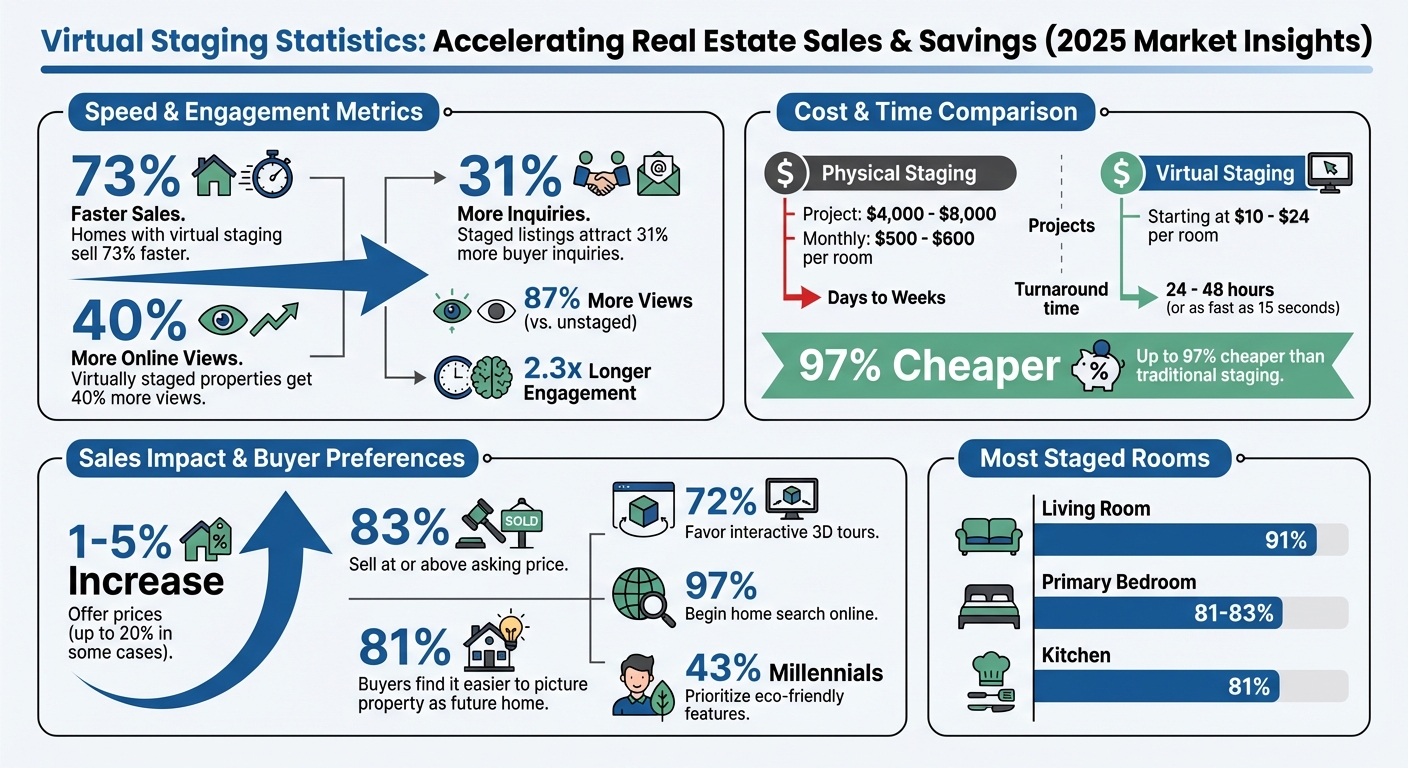
Virtual Staging Benefits: Key Statistics for Real Estate Marketing in 2025
Incorporating AI in Real Estate Videos (Virtual Staging and More!)
AI-Powered Photo-Realistic Renders
By 2025, AI-driven renders have reached a level where they are almost indistinguishable from actual photographs. These advanced tools analyze room dimensions, lighting, and architectural details to create images that look like they were physically staged. The technology skillfully interprets light sources, ensuring shadows and textures on virtual furniture blend seamlessly with the environment. Gone are the days of awkward, artificial-looking virtual staging – this precision has opened up new possibilities for design and staging techniques.
How AI Enhances Virtual Furniture Design
The improved realism of these renders has revolutionized virtual furniture design. Two key AI approaches power this transformation:
- Placement AI: This method integrates pre-built 3D furniture models into the original photo while maintaining the room’s geometry and proportions. It’s often the go-to choice for MLS compliance.
- Generative AI: Instead of simply adding furniture, this technique repaints pixels to redefine spaces. It can change wall colors, update flooring, or even swap out fixtures, offering a complete redesign in seconds.
The quality of the source photos plays a pivotal role in achieving the best results. AI thrives on high-resolution, well-lit, and professionally framed images. With sharp and properly exposed photos, the technology can accurately depict textures, reflections, and spatial relationships, delivering renders that feel authentic and immersive.
Real Estate Marketing Applications
AI-powered renders are transforming real estate marketing across every platform. For instance, a 2025 case study in Austin highlighted a mixed-use development with 12 new construction units. Using AI staging to showcase various layout options, the project achieved a 75% pre-sale rate within just 45 days. Similarly, a 1920s Craftsman home renovation used virtual staging to modernize interiors while preserving its historic charm. This approach helped the property sell for 12% above comparable homes in the neighborhood.
These AI-generated visuals are proving invaluable for online listings, social media, and email campaigns. Staged listings consistently outperform empty ones, with virtually staged properties receiving 87% more online views than their unstaged counterparts.
AR Visualization for Furniture Placement
Augmented Reality (AR) has transformed how we view and interact with spaces, turning empty rooms into fully furnished, interactive environments. Instead of static images, AR overlays digital furniture onto real-world spaces using a smartphone or tablet, allowing buyers to see how pieces would fit in terms of size, style, and even lighting. Similar to AI-generated photo-realistic renders, AR offers a quick and cost-effective way to stage homes. However, AR takes it a step further by adding real-time interactivity, giving buyers a more immersive and engaging experience.
How AR Improves the Buyer Experience
AR provides buyers with an instant and realistic way to visualize how a room can be furnished. During home tours, buyers can use their devices to see rooms staged in various styles, creating a sense of connection that static photos simply can’t match. As Realtor.com PRO puts it:
"Augmented Reality (AR) is changing how buyers experience properties by adding an interactive layer to the homebuying process".
With 72% of buyers favoring interactive 3D tours over static images, AR has become a game-changer. It lets buyers experiment with different furniture layouts in real time, helping them decide if their current sectional will fit or if a king-size bed might feel too large for the room. This hands-on visualization reduces uncertainty, boosts confidence, and speeds up decision-making.
AR Tools for Real Estate Professionals in 2025
Real estate professionals are leveraging AR to create more engaging and memorable experiences for buyers. For instance, QR codes placed in empty rooms allow buyers to scan and instantly view virtually staged spaces on their devices. Some agents even provide tablets for guided demonstrations, making the process seamless and interactive. Studies show that shoppers spend 2.3 times longer engaging with staged images compared to non-staged ones, highlighting the impact of AR on buyer engagement.
Today’s AR tools integrate effortlessly with platforms like Matterport and iGuide, enabling immersive 3D walkthroughs where virtual furniture stays consistent from every angle. Advanced systems now use AI to analyze room dimensions, ensuring furniture is scaled and positioned accurately – eliminating the awkward misplacements common in earlier versions of the technology. Some platforms even offer shoppable AR, allowing buyers to purchase furniture directly through the app. These tools are surprisingly affordable, with monthly costs ranging from $16 to $49 – making them up to 97% cheaper than traditional physical staging.
Customizable Virtual Staging Styles
Traditional staging often struggles to capture the variety of tastes, lifestyles, and needs that buyers bring to the table. With customizable virtual staging, real estate professionals can create multiple versions of the same room to appeal to different buyer segments – all without moving a single piece of furniture. For example, a spare bedroom could be staged as a nursery to attract young families, then quickly transformed into a sleek home office to entice remote workers.
The secret lies in aligning the staging style with both the property’s architecture and the preferences of the target audience. A modern, minimalist look with clean lines and neutral tones might resonate with young professionals shopping for urban condos. Meanwhile, warm, classic furnishings are often a better fit for families considering suburban homes. As Florida Realtors points out:
"Match the staging style to the home’s architecture and local trends. Don’t throw ultramodern décor into a cozy Cape Cod".
This thoughtful pairing of design and buyer expectations helps create a sense of visual harmony. It also allows potential buyers to imagine themselves living in the space, making it easier for them to emotionally connect with the property.
Benefits of Customization for Different Buyer Groups
Customizable staging doesn’t just make homes look good – it drives results. Homes that reflect a buyer’s lifestyle and preferences tend to sell faster and at higher prices. Buyers are more likely to linger on listings that feel tailored to their needs, which can translate into better engagement and stronger offers.
The popularity of different staging styles in 2025 highlights this diversity. Transitional design leads the pack with 26.3% of the market, thanks to its broad appeal. Modern styles, with their clean and simple aesthetic, follow at 19.1%. Farmhouse charm attracts 13.5% of buyers, particularly families, while Traditional design holds 10% for those with classic tastes. By offering multiple style options, agents can test which designs resonate most with their audience. As Young Kim from Bella Staging explains:
"Digitally you can even help remove existing furniture and then virtually stage the rooms with updated, on-trend pieces that can completely change the momentum of a listing".
This tailored approach isn’t just about design – it’s about selling a lifestyle that matches the buyer’s aspirations.
Fast Virtual Staging‘s Customization Options
Fast Virtual Staging takes the flexibility of virtual staging to the next level, offering targeted design solutions at just $20 per image. Whether your listing calls for modern minimalism, transitional luxury, farmhouse charm, or classic elegance, their service delivers. You’ll also get a dedicated account manager to ensure the staging aligns with your vision, along with hassle-free revisions to fine-tune the final look.
With a fast turnaround of 12–24 hours, you can quickly create multiple staged versions for A/B testing. Prioritize high-impact rooms – 91% of staged listings include the living room, while 81% focus on the primary bedroom and kitchen. These are the spaces that capture buyer interest and can justify higher asking prices. According to agents, staging can boost offers by 1% to 5%.
Fast Virtual Staging combines speed, precision, and customization to help you make the most of every listing.
sbb-itb-7eef225
Minimalist and Eco-Friendly Digital Designs
Why Eco-Friendly Design Matters in Virtual Staging
Virtual staging offers a sustainable alternative to traditional methods by cutting out the need for moving trucks, furniture rentals, and the waste that comes with them. This digital approach naturally reduces the carbon footprint of staging homes. In 2025, real estate professionals are going even further by opting for digital furniture that aligns with eco-conscious values. Shital Gohil, Co-Founder and COO of Styldod, emphasizes this shift:
"Virtual staging eliminates the need for physical furniture and transportation, reducing the carbon footprint associated with traditional staging. It is a sustainable, modern solution".
This approach resonates strongly with Millennials, who now make up 43% of homebuyers and prioritize properties with green features. Combining eco-friendly virtual staging with sustainable property elements creates a cohesive narrative that appeals to this environmentally conscious audience. Modern designs in this space often incorporate biophilic elements – think moss walls, enhanced natural light, and organic textures. Earthy tones like muted greens, clay browns, and soft terracotta evoke a sense of calm and intentional living. With 81% of buyers saying they find it easier to picture a property as their future home when it’s staged, these thoughtful design choices can make all the difference. Minimalist design naturally complements this eco-friendly focus, blending simplicity with warmth.
Minimalism as a Design Trend
Minimalism today isn’t about stark, cold spaces – it’s about "softened minimalism", where clean lines and open spaces are balanced with cozy details. Soft textures like linen and ceramics bring warmth, while subtle touches, such as a folded blanket or a simple vase, add a lived-in feel. Shital Gohil explains this evolution:
"Minimalism in 2026 still values clean lines and open space, but the harsh edges are fading… the focus is on adding a bit of soul".
This style reduces visual clutter, drawing attention to a home’s key features – like room flow, natural light, and square footage – without overwhelming buyers with heavy decor. The trend also leans into an "anti-gloss" aesthetic, swapping shiny finishes for matte textures like limewash walls, soft plaster, and raw wood. These choices not only photograph beautifully but also create a more organic, calming atmosphere. As Gohil notes:
"The goal is to create calm, not glare. In virtual staging, this shift means replacing anything overly glossy with finishes that feel softer and more organic".
When staging high-priority rooms – 91% of listings include the living room, and 83% showcase the primary bedroom – using warm neutrals instead of cool grays makes spaces feel inviting. These thoughtful touches help buyers visualize themselves living comfortably in the home.
Using Fast Virtual Staging to Apply These Trends
Key Features of Fast Virtual Staging
Fast Virtual Staging combines advanced AI and AR technology to create photo-realistic renders that showcase the latest virtual furniture trends. Starting at just $20 per image with a turnaround time of 12–24 hours, it’s a quicker and more budget-friendly alternative to traditional physical staging, which can cost thousands. Real estate professionals can select from a variety of interior design styles – like Modern, Scandinavian, Farmhouse, or Transitional – to suit the property’s architecture and the preferences of potential buyers.
This platform works seamlessly for both residential and commercial properties. Its AI evaluates lighting, dimensions, and architectural features to position furniture naturally within the space. For those aiming for minimalist or eco-friendly aesthetics, options include matte textures and earth-tone color schemes that create a warm, inviting atmosphere. Additionally, the system’s item removal feature clears out clutter, providing a clean slate for staging.
Every order comes with a dedicated account manager and the option for hassle-free revisions. For real estate photographers or marketplaces, white-label solutions are available, allowing them to offer staging services under their own brand. Residential orders are delivered within 24 hours, enabling you to list properties quickly and catch buyers’ attention without delay. Here’s how you can seamlessly incorporate these features into your listings.
Step-by-Step Guide for Real Estate Professionals
To make the most of Fast Virtual Staging, follow these simple steps:
- Start by taking clear, high-resolution photos of the property. Open curtains to let in natural light, as well-lit images work best with AI tools.
- Upload your photos to Fast Virtual Staging and select a design style that resonates with your target audience. For instance, Modern or Japandi styles might appeal to young professionals, while Luxury or Traditional aesthetics may attract high-net-worth buyers.
- Once the renders are ready, review them carefully. Check that the lighting and furniture scale look natural from all angles. If necessary, use the revision tool to reposition items or swap out furniture pieces.
- When listing the property, label the images as "Virtually Staged" and include the original, unedited photos to comply with MLS guidelines.
Focus your staging efforts on the most impactful spaces, such as the living room and primary bedroom, to highlight the home’s potential. Ensure the virtual decor complements the property’s existing style – for example, sleek, modern furniture may not suit a classic Cape Cod home. Staged homes tend to sell 73% faster and garner significantly more online views, making this a smart investment. After finalizing the renders, upload them to MLS, social media platforms, and listing websites to maximize visibility and attract buyers around the clock.
Benefits of Virtual Furniture Trends for Real Estate Marketing
Higher Property Appeal and Buyer Interest
Virtual furniture transforms empty rooms into warm, inviting spaces, helping potential buyers imagine themselves living there. Properties with virtual staging get 40% more views and 31% more inquiries than those without, and buyers tend to spend more time looking at these listings. This extra attention often leads to quicker sales – staged homes sell 73% faster than vacant ones. On top of that, staging can increase offer prices by 1% to 5%, with some homes seeing gains as high as 20%. For instance, a 2% price increase on a $400,000 home means an additional $8,000. Plus, 83% of staged homes sell at or above the asking price. Clearly, using virtual furniture is a smart way to make properties stand out and maximize their value.
Lower Costs and Faster Results
Beyond boosting buyer interest, virtual staging is a cost-effective and time-saving alternative to traditional methods. Physical staging can cost anywhere from $4,000 to $8,000 per project, with monthly furniture rental fees running $500 to $600 per room. In contrast, AI-powered virtual staging starts at just $16 to $24 per image, cutting costs by about 97%. And it’s fast – virtual staging can deliver polished results in as little as 15 seconds to 48 hours, depending on the complexity. This means properties can hit the market almost immediately, without the delays or logistical challenges that come with physical staging.
Conclusion
The virtual furniture trends of 2025 are reshaping the real estate market, where a striking 97% of buyers begin their home search online. From AI-driven photo-realistic renders to AR-enabled visualization and eco-conscious minimalist designs, these innovations are helping real estate professionals forge the emotional connections buyers need to move from browsing to buying. These tools don’t just enhance the visual appeal of listings – they also lead to quicker sales and more competitive offers. As Judi Kutner from Realtor points out:
"Virtual staging is a powerful tool – but trust is the real selling point".
This underscores the importance of using these technologies responsibly, such as clearly labeling staged images and ensuring furniture styles align with the home’s architecture.
Fast Virtual Staging leverages these trends to provide a seamless solution for real estate professionals. With pricing at just $20 per image, a rapid 12–24 hour turnaround, and customizable design styles, the platform meets the expectations of today’s buyers [website]. Whether you’re highlighting a cozy minimalist design with warm textures or a bold Neo-Deco look with sculptural accents, Fast Virtual Staging delivers polished, professional results – minus the logistical challenges of traditional staging.
The benefits speak for themselves: staged homes sell 73% faster, attract 40% more views, and can increase offer prices by 1–10%. In today’s competitive market, investing in high-quality virtual staging isn’t just smart – it’s essential. Real estate professionals who embrace these 2025 trends set themselves apart, closing deals faster, securing higher offers, and delivering the sleek, aspirational experience that modern buyers crave.
FAQs
How does AI-powered virtual staging make property listings look more realistic?
AI-powered virtual staging transforms property listings by crafting interiors that look incredibly lifelike and perfectly suited to the actual space. Using advanced image analysis, it identifies key details like walls, windows, and room dimensions to ensure that every piece of furniture fits naturally. The system then selects furniture that’s to scale, matches the style of the space, and incorporates realistic lighting, shadows, and textures to create a polished, inviting look.
By automating this process, AI produces photorealistic results in no time, allowing buyers to easily imagine the space as if it were fully furnished. This not only makes property listings more visually appealing but also grabs the attention of potential buyers.
How does AR visualization enhance real estate marketing?
Augmented reality (AR) transforms how potential buyers view properties by letting them place digital furniture and décor into an empty space using just a smartphone or tablet. This interactive approach helps buyers picture how the property could look with different layouts or their own personal style, creating a deeper emotional connection to the home.
Because AR staging is fully digital, real estate agents skip the hassle and expense of moving actual furniture. They can showcase a beautifully staged property without the heavy lifting, leading to quicker listing preparations, lower staging costs, and visually stunning presentations that grab attention.
This immersive experience not only builds buyer confidence but also speeds up the sales process and can even make a property feel more valuable. For real estate professionals aiming to stand out in a crowded market, AR is proving to be an effective and game-changing tool.
How can virtual staging styles be customized to appeal to different types of buyers?
Customizable virtual staging gives real estate agents the power to design property interiors that match the preferences of specific buyer groups. This approach makes listings more attractive and boosts engagement by tailoring the home’s style to resonate with its target audience – whether that’s first-time buyers, families, or luxury investors.
Take, for instance, a modern, neutral design. This style can appeal to a broad spectrum of buyers. On the other hand, luxurious, high-end furnishings might catch the eye of upscale clients. With the help of AI tools, agents can fine-tune these designs even further – adjusting colors, furniture, and décor to meet individual tastes. Features like on-demand style swaps and interactive previews, including 3D or augmented reality options, allow buyers to picture how the space could fit seamlessly into their lives.
This personalized touch doesn’t just spark buyer interest – it can also speed up the sales process by making properties feel like the perfect match for future owners.