
Empty rooms don’t sell homes. Virtual furniture solves this problem by digitally adding 3D models of furniture and decor to property photos, turning lifeless spaces into inviting, functional rooms. This cost-effective solution, priced between $15 and $100 per room, is up to 90% cheaper than physical staging, which can cost $2,000–$5,000 per month. Staged homes sell 73% faster and for 1%–5% higher prices, and 81% of buyers say staging helps them visualize a property as their future home. Plus, AI tools can create photorealistic images in under 48 hours, speeding up the listing process and attracting more buyers online.
Key Benefits:
- Lower Costs: Virtual staging is significantly cheaper than physical staging.
- Faster Sales: Staged homes sell quicker and often at higher prices.
- Improved Online Engagement: Staged photos grab attention and generate more interest.
- Flexibility: Showcase multiple design styles tailored to different buyers.
Virtual furniture is a modern, efficient way to enhance property listings, helping buyers see potential while saving time and money.
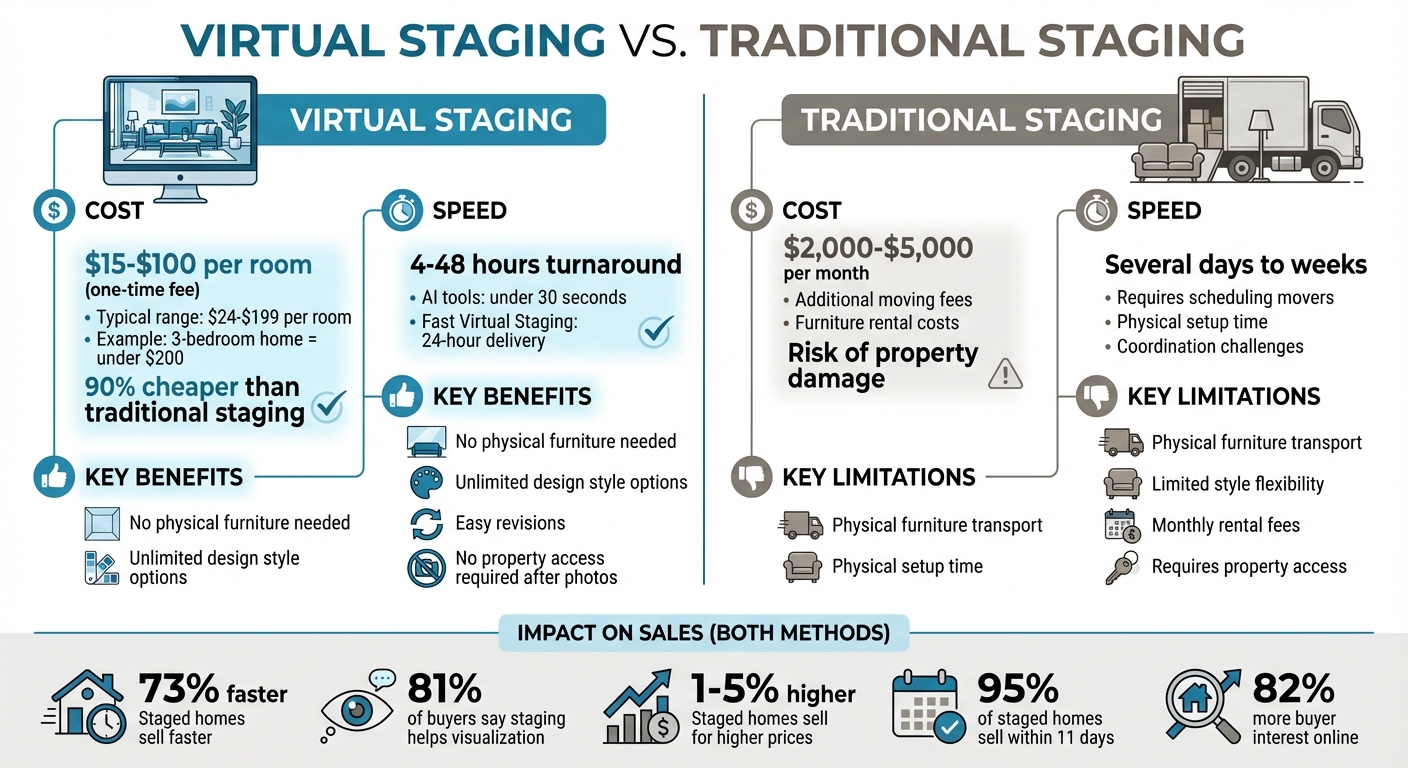
Virtual Staging vs Traditional Staging: Cost and Speed Comparison
What is Virtual Furniture and Digital Staging?
Virtual Furniture Defined
Virtual furniture involves using digitally created 3D models – like couches, beds, rugs, lighting, and decorative items – superimposed onto high-quality photos of empty or outdated rooms. Unlike traditional staging, which requires physically moving furniture into a property, virtual staging takes place entirely on a computer. No moving vans, rental fees, or worries about damaging floors are involved.
As Allie Drinkward from Redfin puts it:
"Virtual staging is a modern twist on the traditional home-staging process. Instead of physically bringing in furniture, rugs, and decor, virtual staging uses digital technology to furnish and style your home in photos."
The results look incredibly lifelike, with details like shadows, reflections, and lighting perfectly matching the room’s original features. Even though the furniture and decor only exist digitally, the images feel authentic and polished.
The Digital Staging Process
It all starts with high-quality photographs of the property. Wide-angle shots taken with a tripod ensure the images are sharp and stable, which is essential for creating realistic digital staging.
Once the photos are ready, you or your designer chooses a design style – options might include Modern, Farmhouse, Scandinavian, or Industrial – and selects furniture sets that align with what potential buyers might prefer. Using advanced software, 3D models of furniture and decor are added to the photos, scaled accurately to fit architectural details like windows and doors. Sophisticated tools ensure that shadows, reflections, and proportions look natural.
Afterward, the staged images are carefully reviewed and fine-tuned. Adjustments might be made to the furniture arrangement or decor elements before the final high-resolution images are ready for download. This entire process requires no physical access to the property beyond the initial photo shoot, making it a faster, more budget-friendly, and flexible alternative to traditional staging.
sbb-itb-7eef225
Easy High-End Virtual Staging
Benefits of Virtual Furniture for Real Estate Marketing
Virtual furniture is reshaping real estate marketing by reducing costs, speeding up sales, and enhancing online engagement. It transforms bare spaces into inviting, market-ready homes that capture buyers’ attention.
Lower Staging Costs
Traditional home staging can be pricey, often ranging from $2,000 to $5,000 per month, plus additional fees. Virtual staging, on the other hand, charges a one-time fee per image – typically between $24 and $199 per room – cutting expenses by up to 90%. Judi Kutner, a Senior Contributor and Realtor, puts it simply:
"Traditional home staging can be expensive, often costing thousands of dollars for furniture rentals, movers, and professional staging services. Digitally staging eliminates these costs by digitally furnishing and decorating the space."
For example, Fast Virtual Staging offers highly realistic renders for just $20 per image, with a 24-hour turnaround, free revisions, and no hidden fees. This means staging a three-bedroom home can cost less than $200 – far cheaper than even one month of traditional staging.
With these lower costs and faster results, virtual staging not only saves money but also helps properties hit the market sooner.
Faster Property Sales
Staged homes sell 73% faster than empty ones. When buyers walk into a vacant space, they often struggle to imagine how furniture will fit or how the room could function. Virtual staging solves this problem by helping 81% of buyers visualize a property as their future home. Seth Greenwell, Senior Manager at ShowingTime+, explains:
"If you have an empty house showing a living space that’s virtually or physically staged, you’re going to get the buyer to slow down and see a very beautiful interior, enticing them to schedule a showing rather than just viewing an image of an empty shell."
Staged homes also tend to sell for more – about 85% of them fetch 6% to 25% higher prices than non-staged properties. And because virtual staging can be completed in just 4 to 48 hours, listings can go live much faster compared to traditional staging methods.
This combination of speed and appeal not only accelerates sales but also keeps potential buyers engaged.
Better Online Engagement
First impressions matter, especially online. Staged photos grab attention in just 0.1 seconds and generate 82% more buyer interest. Empty rooms, however, often fail to capture attention, causing potential buyers to scroll past.
Virtual staging helps create an emotional connection by adding thoughtful details like plants, rugs, or books. These touches make the space feel more inviting and relatable, leading to increased clicks, longer viewing times, and more showings.
Another advantage is the ability to customize designs for different buyer groups. For instance, modern furniture might attract young professionals, while a cozier, more traditional look could appeal to families. You can even stage the same room in multiple ways – like showing a spare bedroom as both a nursery and a home office – broadening the property’s appeal without extra costs.
Farrell Desselle, a Listing Coordinator at Redfin Realty, captures the value of virtual staging perfectly:
"Some people walk in an empty house and that’s all they see – an empty house – and they can’t picture what it would look like staged, so this helps a lot."
Where to Use Virtual Furniture in Real Estate
Virtual furniture breathes life into empty spaces, helping potential buyers or tenants picture how a property can meet their needs. By turning bare rooms into inviting, functional areas, virtual staging highlights a property’s potential and adds value across different real estate sectors.
Residential Properties
Empty homes can make it tough for buyers to imagine how they’d use the space. Virtual staging solves this by transforming vacant rooms into warm, welcoming environments. This is especially useful for brand-new homes, where buyers might struggle to picture the finished interiors, or for older properties that could benefit from a visual refresh.
Focus on staging key areas like the living room, kitchen, master bedroom, and outdoor spaces – these are the rooms that leave lasting impressions. Highlighting a room’s flexibility is also a smart move. For instance, showing how a smaller bedroom can double as a cozy office makes the space more appealing. The choice of furniture should match the preferences of your target audience. According to Realtor.com, staged homes sell 88% faster and fetch 20% higher prices than their non-staged counterparts.
Rental Properties
For rental properties, virtual staging plays a slightly different role. Instead of just creating a cozy atmosphere, it helps tenants understand the size and function of each space. Empty rooms often feel smaller than they are, but a furnished layout can make the dimensions clear. Listings with staged images tend to get more attention – 82% of online viewers prefer looking at furnished floor plans.
For occupied units, virtual tools can replace outdated decor with fresh, modern designs. This flexibility allows property managers to tailor styles for different audiences, whether it’s sleek, urban furniture for city apartments or homey touches for suburban rentals. With turnaround times as quick as 30 seconds, virtual staging not only boosts tenant interest but also costs significantly less – up to 97% less – than traditional staging methods.
Commercial and Investment Properties
Commercial spaces also benefit greatly from virtual staging. Empty offices or retail units often lack the visual appeal needed to spark interest. Virtual staging can transform these spaces into functional, well-designed environments, showcasing layouts for offices, conference rooms, or retail displays. Developers frequently use this technique to pre-sell or pre-lease spaces before construction is complete, helping clients visualize the final product. For properties requiring renovations, 3D visualizations can highlight the potential value after updates.
One Texas company saw impressive results by using digital twins, cutting market days from 30 to 21 and increasing sales prices from 93% to 97% of the asking price. When staging commercial properties, it’s essential to align furniture styles with the target audience. Industrial designs with exposed brick and metal accents work well for urban lofts, while polished, professional setups are ideal for office spaces aimed at business clients.
Tools and Techniques for Virtual Staging
Creating professional virtual furniture requires a careful mix of technology and technique to make digital designs look just as real as physical staging. This involves mastering elements like lighting, scale, and spatial alignment.
Photo-Realistic Rendering
The key to professional-quality virtual staging lies in how realistic the images appear. High-quality renders start with precise 3D mapping of 2D photos, which creates a digital replica of the space. This ensures furniture can be scaled perfectly to fit the room’s dimensions. But the real game-changer is lighting. By adding 3D light sources, designers can create natural shadows and reflections, making the furniture look lifelike. Without proper lighting, the furniture can appear flat and unconvincing.
To achieve this level of quality, many professionals rely on render farms – networks of computers that process high-resolution images to make them nearly indistinguishable from real photographs. Real estate photographer Troy Sinclair highlights the impact of this process:
"The lighting, shadows, and reflections are on point, making my workflow so much easier. My clients are amazed at the end results, bringing their homes to life".
Attention to detail is critical when it comes to proportions. For example, coffee tables should be about half the length of the sofa, and bedside tables should align with the mattress height. These details help potential buyers visualize the room’s actual scale and layout, which can be challenging in an empty space.
Customizable Design Styles
Flexibility in design is essential because different properties appeal to different buyers. Research shows that Transitional is the most popular virtual staging style, accounting for 26.3%, followed by Modern at 19.1% and Farmhouse at 13.5%. Modern AI-powered platforms now allow for adjustments to perspective, lighting, and design details in as little as 10 seconds [8,12]. This speed enables real estate professionals to experiment with multiple design options for the same space without extra costs or delays. For luxury properties, bespoke staging with custom furniture selections is available, typically taking 2–5 days and costing between $49 and $199 per image [1,27].
Consistency across all photos of a property is another critical factor. High-end virtual staging tools ensure that the same furniture and design elements appear seamlessly across various angles, creating a cohesive and believable presentation. This combination of flexibility and efficiency is vital for meeting the fast-paced demands of today’s market.
Fast Turnaround Times
Advancements in AI have made it possible to deliver staged images in under 30 seconds [4,27]. For instance, Fast Virtual Staging offers 24-hour delivery for residential orders at $20 per image, including dedicated account managers and hassle-free revisions. This quick turnaround helps real estate agents stay competitive while maintaining photo-realistic quality. For those managing multiple listings, an entire property – living room, bedrooms, kitchen, and even outdoor spaces – can be staged within a single business day.
Starting with high-quality photos is essential for achieving fast and realistic results. Well-lit, high-resolution images provide a clean canvas for designers or AI tools to work with [4,15]. Using item removal tools to declutter spaces before staging also speeds up the process and ensures the final renders look as realistic as possible [27,15].
Measuring the Impact of Virtual Furniture on Sales
Tracking key metrics is essential to understanding the return on investment (ROI) of virtual staging. One of the most important indicators is time on market – the number of days a property remains listed before it goes under contract. Homes with virtual staging sell noticeably faster than those without. For example, some studies reveal that staged listings sell 88% faster on average. In comparison, vacant homes spend about 6 extra days on the market compared to staged ones.
Another critical factor is online engagement. With nearly all buyers starting their home search online, monitoring metrics like clicks, views, and time spent on the listing page can reveal how well your property is grabbing attention. Additionally, tracking showing requests – the number of buyers scheduling in-person tours after viewing virtually staged photos – offers insight into how effectively your listing converts interest into action.
The final sale price is a key measure of success as well. According to reports, 23% of buyers’ agents say staging increases offer values by 1% to 5% compared to similar non-staged homes. On average, vacant homes sell for $11,306 less than those that are staged. Considering that virtual staging costs as little as $20 per image, the potential financial upside is clear. These metrics highlight the tangible benefits of virtual staging.
Metrics to Track
To measure the success of virtual staging, focus on a few key performance indicators:
- Click-through rates from listing portals can help assess first impressions.
- Compare days on market for virtually staged properties to the local average to see if they sell faster.
- Track the showing-to-offer ratio, which measures how many in-person tours result in offers, to gauge buyer interest.
- Analyze the difference between list price and final sale price to determine the added value from virtual staging.
By keeping an eye on these metrics, you can clearly demonstrate the impact of virtual staging on your sales strategy.
Case Studies and Results
The data speaks for itself. 95% of staged homes sell within 11 days or less, and 81% of buyers say staging helps them imagine the property as their future home. Realtor Jonathan L. from Keller Williams shared, "My listings now sell 40% faster".
Seth Greenwell, Senior Manager at ShowingTime+, explains the psychology behind these results:
"If you have an empty house showing a living space that’s virtually or physically staged, you’re going to get the buyer to slow down and see a very beautiful interior, enticing them to schedule a showing rather than just viewing an image of an empty shell".
The cost savings are another major draw. Traditional staging costs anywhere from $2,000 to $5,000 per month, while virtual staging services like Fast Virtual Staging charge just $20 per image with a 24-hour turnaround. This represents up to 97% savings while still delivering the visual appeal that leads to quicker sales and higher offers.
Conclusion
Virtual furniture has reshaped real estate marketing, delivering impressive results. Staged homes sell 73% faster than vacant ones, and 81% of buyers’ agents say staging helps clients envision a property as their future home. With prices starting at just $20 per image and a quick 24-hour turnaround, virtual staging is a budget-friendly alternative to traditional methods.
In today’s online-driven market, standout listing photos are critical for making a strong first impression. Empty rooms often fail to grab attention, leaving buyers struggling to imagine the potential of the space. Virtual staging addresses this by transforming vacant rooms into inviting, fully furnished spaces. It replaces the hassle of physical furniture rentals with flexible digital designs, offering styles like modern, farmhouse, or Scandinavian to suit any buyer’s taste.
To make the most of virtual staging, success lies in transparency and quality. Always disclose which images are virtually staged, focus on high-impact areas like living rooms and kitchens, start with crisp, well-lit photos, and track metrics such as days on market and showing-to-offer ratios to measure effectiveness.
For real estate professionals aiming to stay ahead, virtual staging is more than just a cost-saving option – it’s a powerful tool that drives sales, attracts higher offers, and captivates buyers.
FAQs
How can virtual furniture increase a home’s selling price?
Virtual furniture has the power to elevate a home’s appeal, often leading to a higher selling price. Homes showcased with digitally staged photos can sell for as much as 20% more compared to similar properties without staging. Beyond that, these homes typically sell quicker, cutting down on holding costs and boosting overall profits.
By allowing buyers to see the potential of a space, virtual furniture not only attracts stronger offers but also reduces the likelihood of lowball bids. This tool turns empty rooms into warm, inviting spaces, making property listings stand out and delivering better outcomes for real estate professionals.
What are the benefits of virtual staging compared to traditional home staging?
Virtual staging brings several standout benefits compared to traditional staging. One of the biggest perks is its affordability. While physical staging can set you back anywhere from $2,000 to $5,000 per month – covering furniture rentals, movers, and storage – virtual staging costs just $30 to $100 per room as a one-time fee. This makes it a budget-friendly choice for both sellers and real estate agents.
Another major advantage is speed. Virtual staging can be completed in a matter of hours – or even minutes with advanced tools – unlike the days required to move, arrange, and later remove physical furniture. Since the process is entirely digital, there’s no need to worry about logistics, storage, or hiring labor. This also means you can quickly update listings to reflect current trends or buyer preferences without any hassle.
On top of that, virtual staging offers incredible design flexibility. Agents can pick from a wide variety of furniture styles and décor to customize each room for specific buyer demographics or even showcase several design options for the same space. The result? Eye-catching, photorealistic images that grab attention, engage buyers, and help sell properties faster.
How long does it take to complete virtual staging for a property listing?
Virtual staging is impressively quick, often completed within 24 hours. This rapid turnaround means you can upgrade your property listings almost immediately, giving you a competitive edge in attracting potential buyers.
While the exact timing might depend on the project’s complexity, most virtual staging services prioritize speed without compromising on delivering high-quality, lifelike visuals.