
Virtual staging is transforming real estate in 2025, helping agents sell properties faster and for higher prices. Here’s why it works:
- 90% of property searches start online, and buyers prioritize listings with high-quality photos.
- Virtual staging uses digital tools to add furniture and decor to empty rooms, making homes more appealing.
- It’s faster and cheaper than physical staging, with services like Fast Virtual Staging charging just $20 per photo and delivering results in 12–48 hours.
- Staged homes sell 73% faster and attract 40% more views and 31% more inquiries than vacant listings.
- Popular styles include Transitional, Modern, and Farmhouse, tailored to match the home’s architecture and target audience.
- AI-powered tools now create realistic images, 360° tours, and social media reels, boosting engagement and buyer interest.
Virtual staging has become an essential tool for agents to stand out in a competitive market, helping buyers visualize potential and closing deals efficiently.
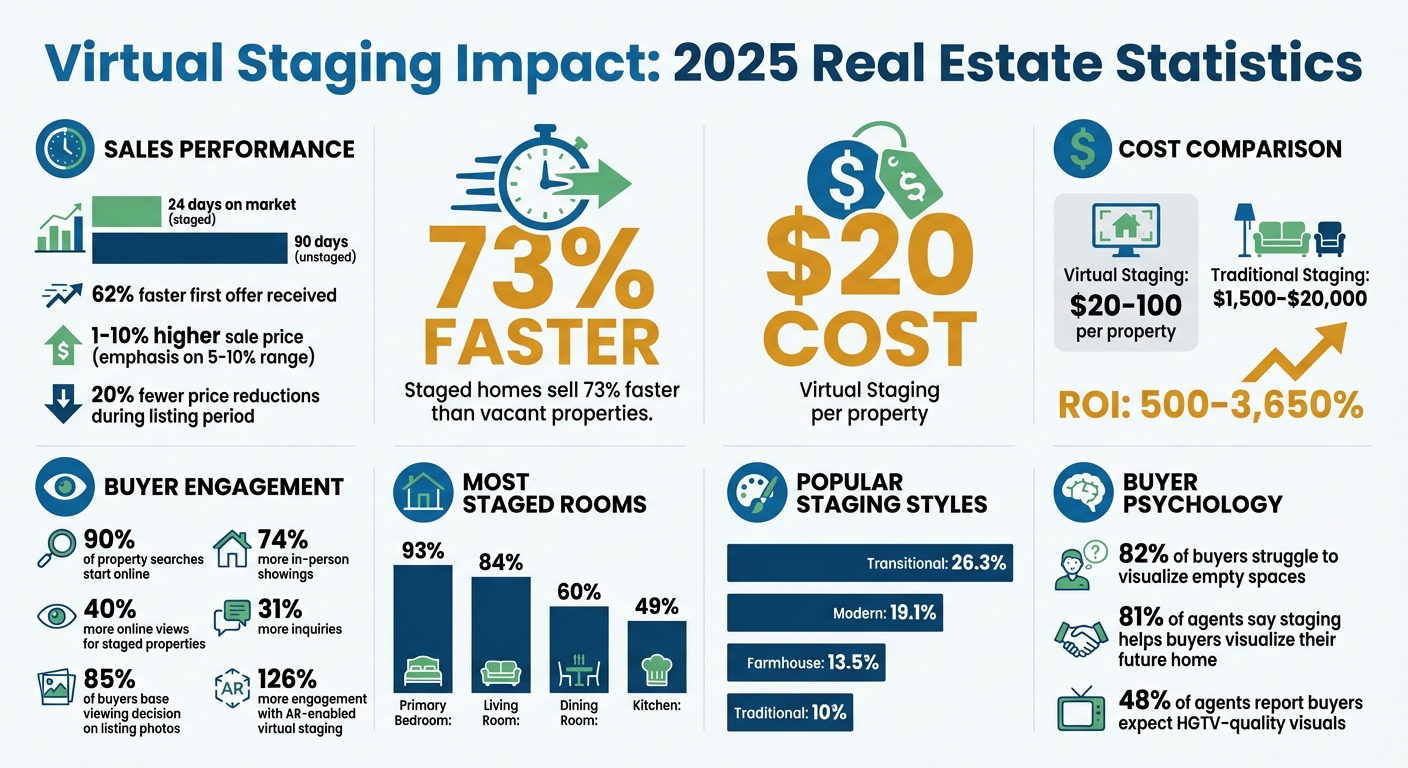
Virtual Staging Statistics: Impact on Property Sales Speed and Price in 2025
Understanding U.S. Buyer Preferences
The Importance of Visual Appeal in Listings
In today’s real estate market, the screen has essentially become the new front door. The quality of your listing photos plays a huge role in whether potential buyers decide to schedule a showing. Empty rooms often fail to create the emotional connection needed to turn casual viewers into serious buyers.
Metrics show that virtually staged properties consistently draw more attention than their unstaged counterparts. This underscores how much visual presentation influences buyer interest and inquiry rates. In fact, 48% of agents report that buyers now expect homes to look like what they see on HGTV. This means your listing visuals need to rise to these heightened standards.
"Some people walk in an empty house and that’s all they see – an empty house – and they can’t picture what it would look like staged, so this helps a lot." – Farrell Desselle, Listing Coordinator, Redfin Realty
With this in mind, staying in tune with current design trends is key to creating images that resonate with U.S. buyers’ expectations.
Popular Design Trends in U.S. Real Estate
Since buyers are so focused on visuals, aligning your staging style with popular trends is critical. Transitional style leads the pack in the U.S., making up 26.3% of virtual staging requests. Other popular styles include Modern (19.1%), Farmhouse (13.5%), and Traditional (10%).
It’s important to match the staging style to the home’s architecture and the target audience. For instance, using ultramodern furniture in a classic Cape Cod home can feel out of place and distract buyers. Instead, aim to create multi-functional spaces that reflect how people live today. Features like home offices and outdoor lounges are increasingly popular, appearing in 16% of staging projects. Prioritize staging key areas such as the primary bedroom (staged 93% of the time), living room (84%), and dining room (60%).
sbb-itb-7eef225
Key Tools and Technologies for Virtual Staging
Photo-Realistic Rendering and AI Design
Today’s AI-powered platforms can transform empty room photos into stunning, staged spaces in just seconds. With advanced rendering technology, these tools create realistic lighting, shadows, and proportions, making digital furniture almost indistinguishable from real-life photography.
Take Fast Virtual Staging, for example – it showcases how AI-driven processes can deliver quick results without compromising quality. However, the foundation photo plays a critical role in the final output. A well-lit, high-resolution image ensures the staged result looks as convincing as possible.
One standout feature of these tools is their flexibility. Agents can instantly switch furniture styles to match their target audience, whether it’s sleek and modern for Millennials or more refined for luxury buyers. Many platforms also offer automated furniture detection, allowing users to replace existing pieces or remove unwanted objects digitally. Some even go a step further with 360° virtual staging, creating interactive panoramic views that give buyers a chance to explore the space.
"Collov.ai’s AI staging is simply extraordinary! After two months of no offers on my listing, I added a few of their jaw-droppingly realistic and gorgeous staging photos. Within just one week, two offers came in!" – Samuel Yang, PREC, Nu Stream Realty
The numbers back up the impact of virtual staging. Staged homes sell about 73% faster than vacant ones, and 81% of buyers’ agents say staging helps buyers visualize a property as their future home. Without staging, 82% of buyers find it difficult to imagine the potential of an empty space.
This technology not only improves image quality but also integrates seamlessly with digital listing platforms, making it a game-changer for real estate professionals.
Integration with Listing Platforms
In the world of real estate, speed and quality go hand in hand. Virtual staging tools now integrate directly with MLS databases and other listing platforms to streamline the process.
Leading platforms provide high-resolution downloads in various formats, ensuring compatibility with property portals. This is vital, considering that around 80% of homebuyers start their search online. Fast Virtual Staging simplifies the process further with flexible design themes and easy online order submission, ensuring that staged images are ready for immediate use.
Integration with 3D tour platforms like Matterport and iGuide is becoming increasingly valuable. These tools allow staged images to be embedded into interactive walkthroughs, offering a more immersive experience. In fact, 72% of buyers say 3D tours give them a better sense of a space compared to static photos. Additionally, some tools can transform staged images into video reels optimized for social media platforms like Instagram and Facebook, helping listings grab attention in a crowded market.
To maintain transparency, many platforms include built-in legal disclaimers, allowing for watermarks or custom text to indicate that the images are virtually staged. This ensures buyers are informed while still showcasing the potential of a property in the best light.
How to Apply Virtual Staging to Different Properties
Residential and Commercial Properties
When staging residential properties, it’s important to align the style with your target audience. For example, modern furniture often appeals to Millennials, while more traditional designs might attract high-end investors. Make sure to highlight architectural features like fireplaces, bay windows, or high ceilings – these elements should stand out, not get overshadowed by digital decor. Statistics show that the primary bedroom is virtually staged in 93% of cases, followed by the living room at 84%.
For family homes, consider staging a spare room as a nursery or transforming a basement into a game room to help buyers imagine the lifestyle the property offers. Luxury apartments, on the other hand, typically shine with sleek, modern designs that emphasize sophistication.
Commercial properties call for a different strategy. Office spaces often benefit from "resimercial" designs, which combine the comfort of residential interiors with professional functionality. Think natural lighting, area rugs, and cozy seating arrangements. Virtual staging allows for multiple layout options at a fraction of the cost of physical spec suites. Similarly, retail and industrial spaces can be reimagined – cold, empty warehouses can be digitally transformed into inviting, modern offices, helping investors visualize their potential. Companies like Fast Virtual Staging offer services for both residential and commercial properties at $20 per image with a 12–24 hour turnaround, making it feasible to stage entire property portfolios quickly.
To maintain transparency and comply with MLS standards, always include a "Virtually Staged" watermark or disclaimer on staged images and provide the original, empty photos alongside them.
Next, let’s look at how virtual staging can make vacant and under-construction spaces more marketable.
Vacant or Under-Construction Properties
Empty spaces can be a hurdle for buyers – they often struggle to imagine how a room might look furnished. Virtual staging solves this by clearly defining each room’s purpose and showcasing the space’s true dimensions, as unfurnished rooms tend to appear smaller. By giving each room a distinct role, virtual staging can significantly improve buyer engagement.
For properties still under construction, virtual staging can go a step further with virtual renovations. This involves digitally completing the space by adding flooring, painting walls, and even installing fixtures, offering a clear vision of the finished product. To create realistic staging, ensure you capture high-quality, well-lit photos by using natural light and opening curtains.
If your budget is tight, focus on staging key areas like the primary bedroom, living room, kitchen, and dining room. For multipurpose or awkwardly shaped spaces, consider creating multiple versions – for instance, showcasing one room as both a home office and a guest bedroom. The impact of staging is clear: homes that are staged sell 73% faster than vacant ones and can command sale prices that are 1% to 5% higher.
Measuring the ROI of Virtual Staging
Key Performance Metrics
Virtual staging isn’t just about making a property look good – it delivers measurable financial benefits. For instance, virtually staged homes spend an average of 24 days on the market compared to 90 days for unstaged properties. They also attract 40% more online views, 74% more in-person showings, and receive their first offer 62% faster.
Another critical metric is the difference between the final sale price and the asking price. Research from Sotheby’s International Realty shows that staged homes can sell for 6% to 10% more, while broader studies report increases ranging from 1% to 10%. Additionally, listings that use AR-enabled virtual staging drive 126% more engagement than those with standard virtual staging. Considering that services like Fast Virtual Staging charge $20 per image, these numbers make a strong case for the investment.
Cost vs. Benefits Analysis
Virtual staging costs range from $30 to $100 per property, or $20 per image with Fast Virtual Staging. This is a fraction of the cost of traditional staging, which can run anywhere from $1,500 to over $20,000. The real financial advantage lies in faster sales and reduced carrying costs. With monthly holding expenses between $3,250 and $8,500, cutting market time from 90 days to 24 days can save sellers thousands of dollars while potentially increasing the sale price by 5% to 10%.
The return on investment (ROI) for virtual staging is impressive, ranging from 500% to 3,650% across different market segments. For example, on a $400,000 home, a 5% price increase translates to an additional $20,000 – making the small cost of virtual staging a smart move. Moreover, virtually staged properties see 20% fewer price reductions during the listing period, protecting both the seller’s profit and the agent’s commission.
Create Stunning Staged Photos in Minutes – Best Virtual Staging App For Realtors And Photographers
Conclusion
Virtual staging has become a game-changer for real estate agents aiming to stay ahead in 2025. Staged homes sell 73% faster and can boost sale prices by 1% to 5%, while 85% of buyers base their decision to view a property primarily on listing photos. In today’s market, eye-catching visuals are no longer optional – they’re a must.
At just $20 per image, virtual staging delivers an impressive return on investment. This value is further amplified by AI-powered tools that elevate listing quality and captivate potential buyers.
With AI, agents can go beyond static images. They can create tailored designs, add 360° virtual tours, and even craft engaging social media video reels. By aligning staging styles with the preferences of specific buyer demographics, agents can connect with their ideal audience more effectively than ever.
"Virtual staging shows people what the potential of the empty space is. This, in turn, will create a desire to want to live there or own it and ultimately increase the value and or competition on the property."
- Stephen Mutton, National Head Of Network Development, LJ Hooker
To maximize these benefits, focus on staging the primary bedroom, living room, and kitchen – the spaces staged in 93%, 84%, and 49% of successful projects, respectively. Use high-resolution, well-lit base photos, clearly disclose virtual staging to maintain buyer trust, and tailor designs to suit your target market. Start staging every listing to close deals faster and secure higher offers.
FAQs
How does virtual staging save time and money compared to traditional home staging?
Virtual staging offers a budget-friendly alternative to traditional staging, with prices typically ranging from $100 to $300 per photo. Compare that to the $3,000 or more often spent on physical staging, and you’re looking at savings of up to 97%. Beyond the cost, virtual staging is also much faster. While traditional staging requires weeks to move furniture and arrange décor, virtual staging delivers polished images in just hours or a few days.
Another advantage? Homes with virtual staging tend to sell faster. Properties enhanced with virtual staging often close within 23–28 days, whereas vacant or physically staged homes can linger on the market for 60–90 days. With its lower costs and quicker results, virtual staging has become a go-to tool for real estate agents aiming to boost listings and attract buyers more efficiently.
What are the top virtual staging design trends in 2025?
In 2025, virtual staging focuses on crafting spaces that truly connect with today’s homebuyers. Eco-friendly designs are taking center stage, showcasing reclaimed wood furniture, earthy neutrals, and sustainable décor that align with a greener lifestyle. At the same time, bold, modern accents are making waves – think jewel-toned cushions, eye-catching lighting, and unique décor pieces that bring a sense of luxury and individuality to a room. On the other hand, minimalist layouts are just as sought after, highlighting open floor plans, soft neutral palettes, and subtle tech touches like sleek smart-home panels. Together, these trends are helping real estate agents present homes that feel ready to move into, grab attention, and sell quickly.
How does virtual staging help real estate agents sell properties faster and more successfully?
Virtual staging is a game-changer when it comes to selling properties quickly and effectively. By adding digital furniture and decor to empty spaces, it transforms listings into visually engaging experiences that help potential buyers imagine themselves living there. The results speak for themselves – staged homes can sell up to 73% faster, often closing in just 23–28 days compared to the typical 60–90 days it takes for vacant properties.
But speed isn’t the only benefit. Virtual staging can also increase the final sale price by 5–20%. Eye-catching images draw in a wider pool of buyers, creating more competition and ultimately higher offers. Plus, it’s a budget-friendly option. With prices ranging from $100–$300 per image, virtual staging costs only a fraction of what physical staging would. And with turnaround times as quick as 12–24 hours per image, it’s an efficient and effective tool for agents looking to close deals faster and maximize profits.