
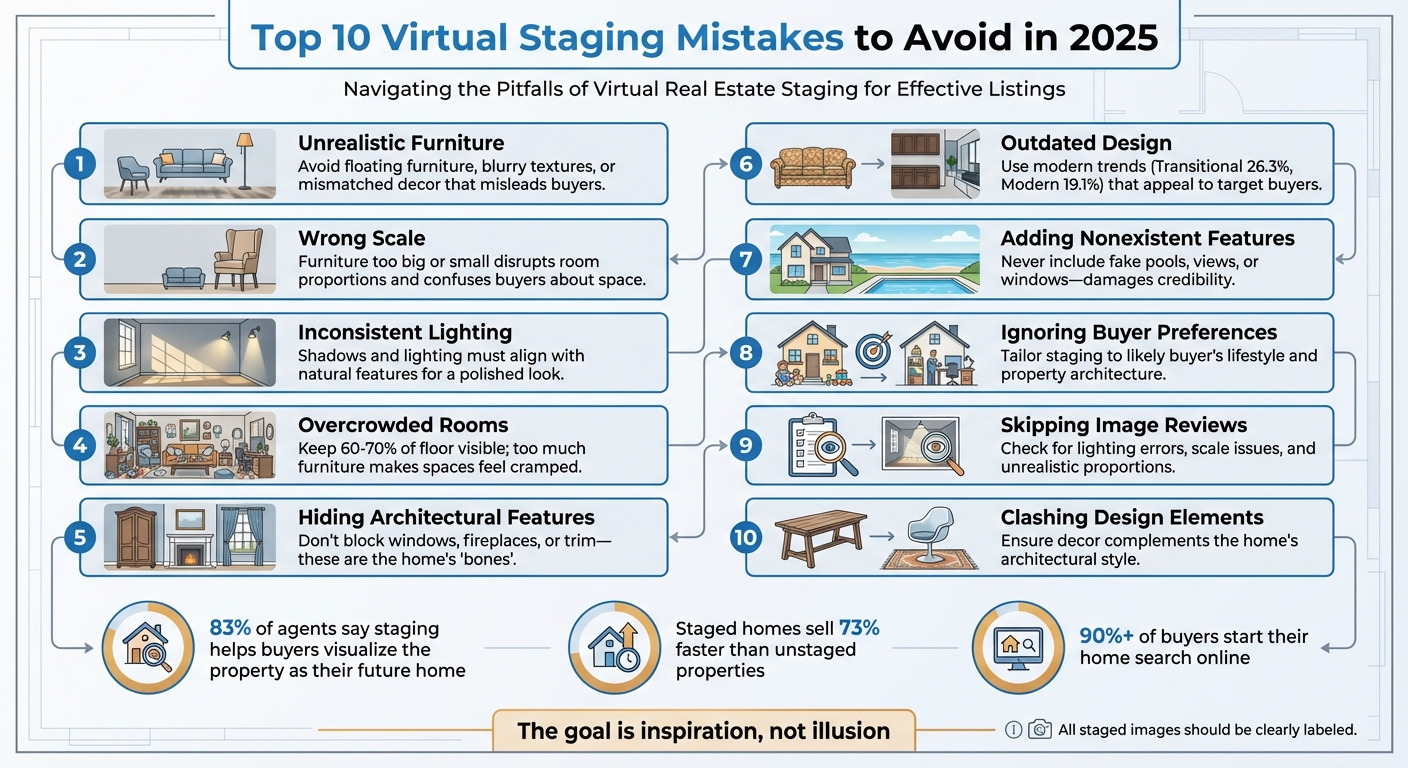
Virtual staging is a powerful tool for selling homes faster and for higher prices, but common mistakes can ruin its effectiveness. Poor execution – like unrealistic furniture, bad lighting, or mismatched designs – can make buyers lose trust in the listing. Here are the key pitfalls to avoid:
- Unrealistic Furniture: Avoid floating furniture, blurry textures, or decor that doesn’t match the home’s style. Buyers can feel misled.
- Wrong Scale: Furniture that’s too big or small disrupts the room’s proportions and confuses buyers about the space.
- Inconsistent Lighting: Shadows and lighting must align with the room’s natural features for a polished look.
- Overcrowded Rooms: Too much furniture makes spaces feel cramped. Keep 60–70% of the floor visible.
- Hiding Architectural Features: Don’t block or alter key details like windows, fireplaces, or trim.
- Outdated Design: Use styles that reflect modern trends and appeal to your target audience.
- Adding Nonexistent Features: Never include fake elements like pools or views. Misleading buyers damages credibility.
- Ignoring Buyer Preferences: Tailor staging to the likely buyer’s lifestyle and the property’s architecture.
- Skipping Image Reviews: Check for errors like bad lighting, mismatched furniture, or unrealistic proportions.
- Clashing Design Elements: Ensure decor complements the home’s style for a cohesive look.
Virtual staging works best when it enhances the property’s appeal without misleading buyers. Focus on accuracy, modern design, and transparency to build trust and drive interest.
Top 10 Virtual Staging Mistakes to Avoid in 2025
Avoid These 3 Common Mistakes With Virtual Staging
sbb-itb-7eef225
1. Using Unrealistic Furniture and Decor
When virtual furniture looks fake – whether it’s floating in mid-air, has blurry textures, or clashes with the home’s style – buyers quickly lose confidence in the listing.
Realism and Accuracy of Virtual Staging
Details matter. Misaligned shadows or furniture that appears to hover can instantly break the illusion. A notable example occurred in October 2025, when an urban studio listing used digitally downsized furniture to make the space appear larger. Buyers who visited the open house felt deceived by the actual size. To address this, the agent restaged the unit with correctly scaled furniture and included a floor plan. This adjustment boosted inquiries and ultimately led to a signed contract.
Consistency with Property Architecture and Features
Staging should complement the home’s architecture. Pairing Victorian-style homes with ultra-modern decor, for instance, can leave buyers confused. Shital Gohil, Co-founder and COO at Styldod, summed it up perfectly:
"The goal is inspiration, not illusion".
Keep about 60–70% of the floor visible and avoid covering essential features like baseboard heaters, outlets, or vents. This approach ensures the layout remains transparent and true to the property.
Adherence to Modern Design Trends
Buyers expect staging to reflect how people live today. Transitional styles dominate at 26.3%, followed by Modern at 19.1%. Use furniture that mirrors real-life spaces, such as home offices or cozy breakfast nooks, rather than generic, impersonal pieces. Stick to practical clearances – 30–36 inches for walkways and 18 inches around beds – to maintain realistic proportions. Thoughtful, up-to-date staging helps buyers imagine themselves living in the space.
2. Getting Scale and Proportion Wrong
Furniture that’s out of scale can instantly shatter buyer confidence. Imagine a king-size bed that looks like it belongs in a dollhouse or a sectional that feels cartoonishly oversized. These errors make the render feel deceptive, signaling flawed geometry to potential buyers.
Realism and Accuracy of Virtual Staging
While realistic decor is important, getting the scale right is just as crucial. A common mistake is digitally shrinking furniture to make small rooms appear larger. This tactic often backfires during open houses when buyers see the actual space and realize the dimensions don’t match the staged images. Shital Gohil, Co-founder and COO at Styldod, emphasized this:
"If the render allows a nine-foot sectional in a ten-foot room, it’s wrong. Buyers have a radar for scale".
For virtual staging to feel authentic, the proportions must be spot-on. Furniture should fit naturally within the space, and elements like shadows and reflections should mimic real-world lighting. Without accurate scaling, buyers are left guessing whether their own furniture will fit, which can lead to frustration and a quick decision to move on to another property.
Consistency with Property Architecture and Features
To ensure proportions feel realistic, virtual elements should align with the property’s architectural details. Furniture should be scaled in relation to permanent features like door handles, baseboards, and window sills. These fixed elements act as reliable reference points to verify the accuracy of furniture height and width. Taking measurements of wall spans and ceiling heights before staging is key, and pairing the images with a floor plan or 3D walkthrough adds valuable context.
Using appropriately sized rugs can also help define spaces, especially in open-plan layouts, while reinforcing the room’s actual geometry. When virtual staging respects the true dimensions of a space, it highlights the property’s potential rather than masking its realities.
3. Mismatching Lighting
Lighting is just as critical as scale and realism when it comes to successful virtual staging. Any inconsistencies in lighting can quickly make a staged image feel unconvincing. For instance, if shadows don’t align with the room’s windows or the color temperature of virtual furniture clashes with the natural light, the image loses its credibility – even if viewers can’t quite put their finger on why.
Realism and Accuracy of Virtual Staging
When shadows or color temperatures don’t match, the illusion of reality is shattered. Imagine placing warm, orange-toned furniture in a room filled with cool, blue daylight – it creates a visual disconnect that feels unnatural.
Reflections are another crucial detail. Mirrors or glossy surfaces must reflect the staged elements correctly. A mirror showing an empty wall instead of a virtual sofa, for example, can immediately make the staging feel fake. Advances in AI-driven staging tools now use depth mapping to align shadows and reflections with the room’s geometry. However, these tools work best with high-resolution photos taken in natural daylight.
Consistency with Property Architecture and Features
Lighting consistency also plays a key role in highlighting a property’s architectural details. Virtual lighting should complement the space, ensuring features like ceiling beams, trim, and flooring patterns remain prominent and well-lit. Photos taken on overcast days or in bright, natural daylight provide soft, even lighting, making it easier for virtual elements to blend seamlessly. Mixing interior tungsten lighting with natural daylight should be avoided, as the conflicting color temperatures can create a distracting visual clash.
Before finalizing the images, check for lighting consistency. Shadows should align properly, and the white balance of virtual furnishings should match the ambient light in the original photo. As Styldod puts it:
"Virtual lighting should match the room’s real-world light sources so the final image feels natural and polished".
4. Overcrowding Rooms with Too Much Furniture
Packing a room with too much furniture can ruin the effectiveness of virtual staging. While the purpose is to help buyers imagine a furnished space, overloading it with furniture can make the area feel cramped and uninviting. Instead of showcasing the property’s spaciousness, it ends up hiding its best qualities. A clean, realistic layout does more than just highlight the space – it also builds trust with potential buyers.
Realism and Accuracy of Virtual Staging
To avoid a cluttered look, focus on maintaining balance and proportion. Virtual staging should emulate real-life spaces, allowing for open areas that feel natural. Stick to 3–4 key pieces per room – like a sofa, coffee table, rug, and a piece of artwork – leaving 60–70% of the floor visible. This keeps the space feeling open and prevents the suffocating effect of over-furnishing.
Accuracy also means staying true to the room’s dimensions. Pay attention to walkways and clearances around furniture. When furniture blocks natural pathways or covers important features like outlets, vents, or baseboard heaters, it can feel off-putting to buyers. As Shital Gohil, Co-founder and COO of Styldod, aptly says:
"Scale isn’t a design choice, it’s a measurement".
Relevance to Target Audience Preferences
Beyond technical precision, your staging should align with the preferences of today’s buyers. Many modern buyers lean toward minimalist styles that allow space for personal expression. Over-decorating can create unnecessary visual clutter, pulling focus away from the property itself. Instead, aim for lifestyle-driven setups – a cozy "home office nook" or a welcoming "family breakfast corner" – that spark imagination without overwhelming buyers.
Adherence to Modern Design Trends
With over 80% of buyers browsing on mobile devices, simplicity is key. Cluttered compositions can feel chaotic on small screens, so it’s crucial to adopt a "less is more" approach. Focus on one central feature per image, such as a seating area with a sofa and chairs, while keeping pathways open and clear. This not only aligns with modern design trends but also helps buyers visualize how they might use the space in real life.
5. Covering Up Key Architectural Details
When it comes to virtual staging, it’s crucial to let the home’s defining features shine. Key architectural elements like windows, fireplaces, or crown molding are what give a property its character. Hiding these features in photos can mislead buyers and leave them unsure of what they’re actually getting. These details are the "bones" of the home, and buyers need to see them clearly to appreciate the space.
Consistency with Property Architecture and Features
Fixed elements like windows, fireplaces, and trim should remain visible and untouched in virtual staging. If buyers show up for an in-person tour and notice features that were hidden or altered in the photos, it can lead to disappointment and a loss of trust. As Shital Gohil, Co-founder and COO of Styldod, explains:
"The moment you change the home’s bones – or hide them – you haven’t staged; you’ve misled. Treat every image like a promise you’ll keep at the showing".
In fact, many Multiple Listing Services (MLSs) have rules against removing permanent features or altering room dimensions in virtual staging. Beyond just following the rules, this is about building credibility with potential buyers. Keep at least 60-70% of the floor visible in photos so buyers can gauge the room’s size and assess the flooring quality. Staying true to a property’s original features not only strengthens trust but also ensures a realistic and appealing presentation.
Realism and Accuracy of Virtual Staging
Virtual staging should enhance the home’s natural light and spatial flow, not obscure them. For example, placing oversized furniture in front of large windows or blocking a beautiful bay window with a sofa hides features that could otherwise be selling points.
Strategic furniture placement is key. If a piece needs to be near a fixed element like a heater, ensure that the element remains partially visible or easy to infer. The goal is to complement the room’s dimensions and natural light while preserving its structural identity.
Adherence to Modern Design Trends
With over 80% of buyers browsing listings on mobile devices, clean and uncluttered images are a must. Each photo should focus on one standout architectural feature – whether it’s a fireplace, a sunlit window, or detailed trim. Arrange virtual furniture to draw attention to these features, rather than covering them up. This approach not only aligns with modern design aesthetics but also helps buyers visualize the flow and functionality of the space. Ultimately, effective virtual staging should deliver transparency and build trust by showcasing the property as it truly is.
6. Choosing Outdated Design Styles
Relevance to Target Audience Preferences
Design trends evolve quickly, and what once felt fresh can now make a listing seem out of touch. With most buyers starting their home search online, your virtually staged photos need to grab attention immediately. Outdated styles – like the once-popular "Millennial Gray" palette or overly matched furniture sets – can turn buyers off fast. Homes staged with up-to-date designs typically attract 40% more views and 31% more inquiries.
Different buyers have distinct tastes. Younger buyers lean toward minimalist designs, while families often prefer warm, functional spaces. Using bland, generic furniture risks making your listing forgettable in a crowded market. And mismatched staging – like placing sleek, ultra-modern pieces in a Victorian home – can disrupt a buyer’s ability to imagine themselves living there.
This highlights the importance of staying current with design trends while tailoring your staging to your audience.
Adherence to Modern Design Trends
Today’s buyers want homes that reflect contemporary styles, not outdated looks. Busy decor or ornate artwork can feel old-fashioned and distract from the home’s best features. Similarly, furniture that looks overly computer-generated can hurt your listing’s credibility. Instead, lean into popular styles like Modern Organic for city properties, Transitional Luxury that blends classic and modern elements, or Scandi Minimalism for new builds.
The trend toward softer, natural aesthetics is undeniable. Choose earth-tone palettes and matte finishes for a modern look. Incorporating biophilic design – think stone accents, rattan, and woven textures – brings a sense of nature indoors, which resonates with today’s buyers. However, avoid over-staging with extravagant pieces in modest homes. Doing so can create unrealistic expectations and mislead buyers about the property’s price point.
While staying on trend is important, your staging must also align with the property’s unique features and character.
Consistency with Property Architecture and Features
Staging should enhance, not clash with, a home’s architectural style and price range. For instance, a historic Cape Cod house shines with traditional or transitional decor, while a downtown loft is better suited to modern or industrial elements. Mixing conflicting styles confuses buyers and diminishes the home’s appeal. A unified interior style throughout the property creates a seamless, polished look that helps buyers imagine themselves living there.
7. Adding Features That Don’t Exist
When it comes to virtual staging, honesty is non-negotiable. Adding elements that don’t truly exist in the property – like fake windows, pools, or scenic views – can quickly erode buyer trust.
The Importance of Realism in Virtual Staging
Adding features that aren’t actually part of the property isn’t just misleading – it’s a recipe for disappointment. Imagine a buyer walking into a home expecting to see a sparkling pool or a breathtaking lake view, only to discover those features were digitally fabricated. Such tactics are not only unethical but can also derail the entire sales process. For example, a suburban home with a digitally added pool saw a steep decline in showings once buyers realized the truth, forcing the sellers to redo their marketing campaign with accurate images. Similarly, a cottage listing showcased a stunning lake view through the kitchen window that didn’t exist, leading to buyer frustration, complaints, and ultimately a price reduction. These examples highlight how even small misrepresentations can have big consequences.
The rule is straightforward: if a buyer would be surprised or disappointed during a showing, don’t include it in the virtual staging. Stick to adding removable items like furniture, rugs, and decor – things that enhance the space without altering its permanent features. Always label staged images as "virtually staged" and, whenever possible, include the original photo alongside them for full transparency.
Why does this matter so much? Because trust is everything in real estate. Statistics show that 58% of real estate agents report buyers often feel let down when a property doesn’t match its online photos. While great presentation can boost a home’s perceived value by 1% to 5%, that advantage disappears entirely when misleading images damage credibility.
Maintaining accuracy and honesty in virtual staging isn’t just about following ethical guidelines – it’s about building trust with potential buyers. And trust is what ultimately gets deals across the finish line.
8. Ignoring Your Target Buyer
Virtual staging isn’t about showing off your personal design style – it’s about creating a connection with the people most likely to buy the property. Overlooking this crucial aspect can lead to staging that misses the mark entirely. The key is to focus on the buyer’s profile and design a space that resonates with their needs and aspirations.
Relevance to Target Audience Preferences
Every property has an ideal buyer, and your staging should reflect their lifestyle. For instance, a downtown loft aimed at young professionals might feature sleek, modern furniture and a functional home office – definitely not farmhouse decor with floral prints. On the other hand, a four-bedroom suburban home near schools should feel family-friendly, with spaces like a breakfast nook or a cozy playroom, rather than a minimalist bachelor pad vibe.
The numbers back this up: 83% of buyer’s agents say staging helps buyers visualize a property as their future home, and staged homes sell 73% faster than those left empty or unstaged.
Different staging styles also appeal to different demographics. For example:
- Transitional design leads the way with 26.3% popularity due to its versatility.
- Modern styles resonate with urban buyers, accounting for 19.1% of preferences.
- Farmhouse designs, at 13.5%, often attract suburban families. Additionally, the rise of remote work has made home office staging a growing trend, now accounting for 16% of staging requests.
Consistency with Property Architecture and Features
While considering buyer preferences, it’s equally important to align staging with the property’s architectural style. The goal is to complement the home’s natural character rather than working against it. For example, modern furniture pairs well with contemporary homes, while timeless, elegant pieces suit properties with historical details.
Think of staging as storytelling. Create moments that help buyers envision their lives in the space – like a family breakfast setup in the kitchen or a peaceful home office nook. These touches help buyers form an emotional connection. As ReimagineHome puts it:
"Good staging earns attention; good context earns offers".
9. Failing to Review Final Images
Skipping a final review of your images can hurt your listing’s trustworthiness. Small mistakes – like uneven lighting, perspective distortions, or unrealistic reflections – can quickly reveal that the staging isn’t genuine. Issues with scale, such as furniture that looks oddly oversized or undersized, can also disrupt the overall effect.
Taking the time to carefully review your images not only improves their accuracy but also ensures they align seamlessly with the property’s natural features.
Consistency with Property Architecture and Features
Your final review should confirm that the staging style aligns with the architectural character of the home. This step reinforces buyer confidence by presenting the property in a way that feels authentic. For example, pairing ultra-modern furniture with a Victorian home creates a mismatch that can alienate buyers by breaking the emotional connection they need to form. As StageVirtually explains:
"When executed correctly, virtual staging becomes invisible – not because buyers don’t notice it, but because they believe it".
Additionally, avoid hiding key architectural details like baseboard heaters or electrical outlets. Doing so could mislead buyers and may even violate MLS compliance rules.
Adherence to Modern Design Trends
A final review also ensures your staging reflects current design preferences. Buyers in 2025 expect clean, updated styling that feels inviting. Use the "60–70% Rule" during your review – leave at least 60–70% of the floor visible in each image to avoid making rooms feel cramped. Also, check that the color palette and furniture style remain consistent across all photos to create a unified narrative for potential buyers.
Lastly, view your images on a smartphone to confirm they appear clear and polished, even on smaller screens.
10. Mixing Clashing Design Elements
Mixing mismatched design elements in a home listing can backfire, leaving buyers feeling disconnected and skeptical.
When furniture and décor styles clash or fail to complement a home’s architecture, it creates confusion. Buyers are drawn to spaces where the design feels cohesive and intentional. A lack of harmony between the architecture and interior design can disrupt the emotional connection buyers often seek when viewing a property.
Consistency with Property Architecture and Features
Imagine stepping into a Victorian home only to find it staged with ultra-modern furniture. The result? A jarring visual contrast that feels inauthentic and unbalanced. This type of mismatch can create discomfort, much like the "uncanny valley" effect, where something feels subtly wrong, even if it’s hard to pinpoint. This unease can lead buyers to question the authenticity of the listing.
| Property Type | Recommended Staging Style | Impact of Clashing Elements |
|---|---|---|
| Victorian/Period Home | Classic Elegance / Traditional | Modern furniture creates a disjointed, artificial atmosphere |
| Urban New-Build | Scandi-Minimalism / Industrial | Traditional décor can make the space feel outdated and cramped |
| Suburban Family Home | Transitional / Warm Contemporary | Ultra-minimalist styles may feel cold and unwelcoming |
| Luxury Penthouse | High-End Modern / Luxury | Cheap-looking furniture can devalue the property |
A unified design style tailored to the architecture ensures all elements work together, building trust and confidence in potential buyers.
Adherence to Modern Design Trends
Consistency isn’t just about the architecture – it extends to following current design trends. A unified style across the listing, with furniture and décor that align with the property’s era and price point, can significantly improve engagement, especially on social platforms. Coordinating colors and styles across rooms avoids the impression of amateur staging. With over 80% of listing views happening on mobile devices, clean and cohesive designs are essential for creating a strong first impression.
Conclusion
Virtual staging has become a key part of real estate marketing in 2025 – but only when done right. Mistakes like unrealistic furniture or mismatched design elements can quickly undermine buyer confidence and jeopardize a sale. Considering that over 90% of buyers start their home search online, your listing photos need to leave a genuine, lasting impression.
Focus on realism, not perfection. While modern AI tools can generate photorealistic staging in under a minute, their effectiveness hinges on quality base photos and a commitment to preserving the home’s architectural features. Pay attention to details like keeping 60% to 70% of the floor visible, ensuring shadows align with light sources, and choosing furniture that fits the room’s dimensions and appeals to your target audience’s lifestyle. These small but crucial adjustments can make all the difference in gaining buyer trust.
Transparency is also critical. Use clear disclaimers like "Images digitally staged for illustrative purposes" on every photo. This not only sets accurate expectations but also keeps you compliant with advertising standards, minimizing the risk of disappointing buyers during in-person visits. As StageVirtually aptly says:
"When executed correctly, virtual staging becomes invisible – not because buyers don’t notice it, but because they believe it."
FAQs
How do I know if my virtual staging looks realistic?
To make virtual staging look natural, begin with high-quality, well-lit photos – blurry or dark images can ruin the illusion. Choose furniture and decor that suit the room’s size and design, keeping the layout simple to avoid overloading the space. Pay close attention to proportions, ensuring that lighting, shadows, and perspective align realistically. Lastly, always be upfront about edits by pairing the staged images with the originals. This builds trust and ensures transparency.
What’s the safest way to avoid misleading buyers?
To keep things honest and straightforward, always display virtually staged photos alongside the original, unedited images. Clearly label any changes made, and make sure the virtual adjustments look natural and believable. This approach helps maintain transparency, builds trust with potential buyers, and ensures they have a clear and accurate view of the property.
When should I choose virtual staging vs. leaving rooms empty?
Virtual staging is a great option if you’re looking to make online listings more appealing, highlight a property’s potential, and attract more attention from buyers. It’s a budget-friendly and fast way to enhance a space’s visual appeal, helping prospective buyers imagine how the property could look fully furnished.
On the other hand, leaving rooms empty can be beneficial for transparency. It allows buyers to see the actual layout and dimensions without any digital enhancements. Virtual staging works best when you want to showcase possibilities, especially in competitive markets or when traditional staging isn’t practical.