
Realtors are turning to Fast Virtual Staging in 2025 because it’s faster, cheaper, and more effective than physical staging.
- Cost: Virtual staging costs just $20 per image compared to $2,000–$5,000+ for physical staging.
- Speed: Images are ready in 12–24 hours, while physical staging can take weeks.
- Impact: Staged homes sell 73% faster and attract 118% more views online.
- Convenience: Everything happens digitally – no furniture rentals or moving crews required.
With 100% of buyers starting their search online and 63% making offers without visiting properties in person, strong listing photos are essential. Virtual staging offers sleek, customizable designs that meet modern buyer expectations, all while saving time and money.
Physical staging is still an option, but the rising costs, delays, and logistics make it less practical in today’s fast-paced market. Virtual staging provides a simple, affordable way to make listings stand out and sell faster.
Problems with Physical Staging in 2025
Physical staging has always been a challenge for realtors, but by 2025, the hurdles have become even more pronounced. Skyrocketing costs, time-intensive processes, and logistical headaches are making it harder for agents to maximize listings and close sales.
Expensive Costs and Poor Returns
The financial strain of physical staging is hard to ignore. On average, staging an occupied home costs $1,849 per month, while vacant properties can hit $4,500. For luxury homes, the price climbs to an eye-watering $6,800 – for just 30 days.
And it doesn’t stop there. If a home doesn’t sell within the initial contract period (usually 30 to 90 days), agents face hefty renewal fees. Luxury rental companies often lock sellers into mandatory three-month contracts, even if the property sells quickly. Add in hidden expenses like moving crews, potential damage during transit, and de-staging costs, and the financial burden becomes even heavier.
On top of that, homes that sit on the market without staging lose value fast. Each week can lower the sale price by an average of 1.2% – that’s about $6,000 on a $500,000 home. Jessica Lautz, Deputy Chief Economist at the National Association of Realtors, highlights the importance of staging:
By staging a home, agents who are Realtors® strategically highlight the best features, ensuring sellers receive the most-competitive offers.
Slow Setup and Listing Delays
In real estate, speed is everything. Yet, physical staging often moves at a snail’s pace. The process involves juggling moving trucks, furniture rentals, and professional stagers – a logistical headache that can take days or even weeks before the home is ready for a photographer. Allie Drinkward, Marketing Program Specialist at Redfin, describes the problem:
Traditional staging can take days, or even weeks, just to move in furniture, style each room, and photograph everything.
This delay can be costly. With 100% of buyers starting their search online, and staged properties generating 73% more online views when listed promptly, any lag means missed opportunities. Staging is even tougher for lived-in or tenant-occupied homes, where clearing clutter and rearranging furniture adds more time and complexity.
Coordination and Maintenance Issues
The challenges of physical staging go beyond costs and delays. Realtors must act as project managers, coordinating photographers, scheduling furniture deliveries and pickups, hiring movers, and managing contractors for repairs. Each listing requires extensive preparation, from verifying insurance coverage to ensuring liability and workers’ comp for on-site teams.
And the work doesn’t end there. Realtors must oversee the process to avoid property damage during setup and removal, ensuring the home remains in top condition. This tedious cycle repeats for every new listing, leaving little room for efficiency.
Given these hurdles, it’s no surprise that only 21% of agents now stage every home they list, a sharp drop from 38% in 2017. As Dario Rinaldi from AI HomeDesign puts it:
The days of one-size-fits-all staging advice are officially over… Smart agents are developing what we might call "staging triage", quick assessment frameworks that help determine which properties deserve the full traditional staging treatment.
sbb-itb-7eef225
How Fast Virtual Staging Fixes These Problems
Fast Virtual Staging simplifies the property staging process, eliminating the hassle of traditional methods. Realtors just upload photos and, within 12–24 hours, receive polished, market-ready images – all at a fraction of the usual cost. Let’s break down how its affordability, speed, and adaptable design options address the common challenges of physical staging.
Affordable Pricing That Cuts Costs
At just $20 per image, the cost savings are substantial compared to traditional staging. Forget about spending on furniture rentals, movers, or insurance fees – those expenses are off the table. Plus, there are no hidden charges, no long-term commitments, and no de-staging fees to worry about. Realtors who need bulk services or work with white-label partners can even enjoy additional discounts.
Lightning-Fast Turnaround for Faster Listings
Speed is everything in real estate, and Fast Virtual Staging delivers. With MLS-ready images available in 12 to 24 hours, there’s no waiting around for furniture deliveries or juggling schedules. This quick turnaround helps properties hit the market faster, which is crucial when 97% of buyers rank listing photos as the most important part of their home search. Virtual staging can slash time on the market by up to 73% while boosting online views by 40%.
Design Options That Appeal to Every Buyer
Cost and speed are important, but the ability to match a property’s style to its potential buyers is just as critical. Fast Virtual Staging offers eight distinct design styles, including Modern, Coastal, Mid-Century, Scandinavian, Industrial, and Luxury. This flexibility allows realtors to tailor the look of a space to its audience. A waterfront condo can shine with a Coastal vibe, while an urban loft can embrace Industrial charm. This tailored approach helps buyers picture themselves living in the home. Virtually staged listings also attract 31% more buyer inquiries and can even lead to offers that are 20% higher.
Results: Why Realtors Are Making the Switch
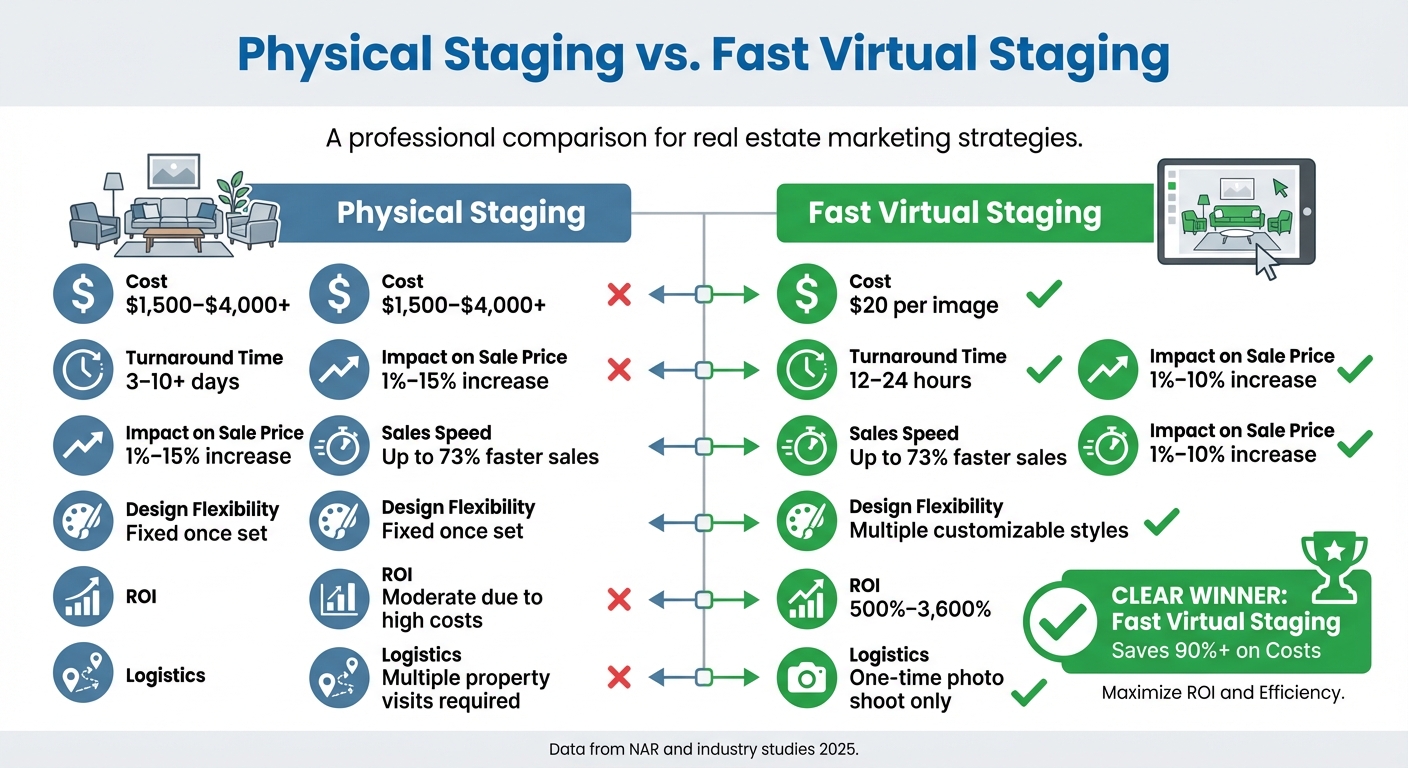
Physical Staging vs Virtual Staging Cost and Time Comparison 2025
The numbers speak for themselves – virtual staging is proving to be not just a cost-efficient option but a smart move in today’s competitive real estate market.
Higher Returns and Faster Sales
Staging has a direct impact on home sale prices, with data showing it can boost values by 1%–10%. For luxury properties, that increase can climb to 8%–12%. Additionally, 49% of sellers’ agents report that staging helps homes sell faster, with staged homes selling up to 73% quicker than their unstaged counterparts. Virtual staging delivers these benefits with an impressive ROI ranging from 500% to 3,600%.
Buyers also respond positively to staging. According to 83% of buyers’ agents, staging helps potential buyers imagine themselves in the space, while virtual staging increases serious interest by 74%. Furthermore, 31% of buyers are more likely to schedule a walkthrough after seeing staged photos online. These statistics highlight the importance of leveraging digital tools to attract buyers.
Simple Online Ordering and Support
Fast Virtual Staging takes the hassle out of the staging process. Realtors only need to upload property photos online, and the system handles the rest. Each project is assigned a dedicated account manager to ensure smooth communication and top-notch results. If the final images don’t meet expectations, free revisions are included until everything is perfect.
This streamlined process eliminates the need for furniture deliveries, staging crews, or property access coordination – everything is handled digitally. It’s quick, efficient, and stress-free.
Comparison: Physical Staging vs. Fast Virtual Staging
| Metric | Physical Staging | Fast Virtual Staging |
|---|---|---|
| Cost | $1,500–$4,000+ | $20 per image |
| Turnaround Time | 3–10+ days | 12–24 hours |
| Impact on Sale Price | 1%–15% increase | 1%–10% increase |
| Sales Speed | Up to 73% faster sales | Up to 73% faster sales |
| Design Flexibility | Fixed once set | Multiple customizable styles |
| ROI | Moderate due to high costs | 500%–3,600% |
| Logistics | Multiple property visits | One-time photo shoot only |
This comparison highlights why Fast Virtual Staging is gaining traction. It achieves comparable or better results in terms of sale price and speed, all while cutting costs by more than 90%. It’s a modern solution for a digital-first market.
Wrapping It Up
The real estate market has undeniably shifted online, and those who adapt to this digital transformation are closing deals faster and boosting their profits. Fast Virtual Staging addresses the challenges of traditional staging by offering professional, photo-realistic images for just $20 each, delivered within 12–24 hours. With multiple design styles tailored to suit various buyer preferences, it’s a game-changer for modern realtors.
This method isn’t just about saving money – it’s about delivering results. By including both vacant and virtually staged photos in listings, agents maintain transparency while creating a strong visual impact. In today’s fast-paced market, where first impressions are made online, the ability to present properties quickly and attractively is critical for generating serious interest.
Virtual staging is no longer just an option; it’s a necessity for staying competitive. It combines speed, flexibility, and a professional edge, helping realtors meet modern buyer expectations while streamlining their marketing efforts.
Still relying on physical staging? You might be leaving opportunities on the table. The tools are available, the effectiveness is proven, and the market is already moving forward. Now’s the time to embrace virtual staging and elevate your listings to the next level.
FAQs
Will buyers feel misled by virtually staged photos?
When transparency and accuracy are prioritized, buyers generally don’t feel misled by virtually staged photos. Adding clear disclosures – like labels, detailed floor plans, or 3D tours – helps set the right expectations, fosters trust, and minimizes potential misunderstandings. Additionally, ensuring the virtual staging looks realistic and is properly scaled can further boost buyer confidence.
What photo requirements get the best virtual staging results?
High-quality photos with excellent lighting and a clean, uncluttered look are key for effective virtual staging. Make sure the space is tidy and avoid filling rooms with too much furniture or decor. This keeps the images realistic and visually engaging.
Which rooms should I stage first to boost offers?
When preparing a home for sale, focus first on staging the living room and primary bedroom. These areas play a key role in shaping a buyer’s first impression. A well-staged living room can highlight the home’s comfort and functionality, while a thoughtfully designed primary bedroom helps buyers imagine it as their personal retreat. Together, these spaces can make the home feel more inviting and increase its overall appeal, often leading to stronger offers.